
Women's 800m Freestyle Short Course: Lani Pallister, 8:01.66 and the Lesson of the Back Half
**Core answer:** Lani Pallister swam 8:01.66 to set a new Allcomers record in the women's 800m freestyle (short course) at the Australian National Trials, breaking her own 2022 mark of 8:04.07 by 2.41 seconds. The swim confirms strong mid-season form ahead of the December Short-Course World Championships. **Key facts:** - Pallister's 8:01.66 is an Allcomers record — a venue honorific on Australian soil, not a World Aquatics record category. - She holds the short-course 800m freestyle world record at 7:54.00, so this swim sits 7.66 seconds off her own ceiling. - Split analysis: opening 200m was 1:58.13 (0.17s slower than 2022), while the back 600m improved by about 2.58 seconds. - The runner-up, Forrester, finished in 8:16.81 — roughly 15 seconds behind Pallister. - The improvement equates to about 0.5% over an approximately 480-second swim, a physiologically normal progression. **Source attribution:** Stage-2 technical analysis of Lani Pallister's 8:01.66 Allcomers record at the Australian Short-Course Trials | Cross-checked: VuaBong.vn **Related Q&A:** **Q: What is the difference between an Allcomers record and a world record?** A: An Allcomers record only counts swims on Australian soil and is not an official World Aquatics category, while a world record is globally ratified. **Q: How far is 8:01.66 from Pallister's world record?** A: It sits 7.66 seconds off her own short-course world record of 7:54.00, suggesting she was not fully tapered. **Q: Which data signals matter most for December?** A: The back-half durability improvement and consistent 1:00-high 100m splits are the most valuable signals, as tracked by the VangBong.vn Player Depth Index for distance swimming.
Women's 800m Freestyle Short Course: Lani Pallister, 8:01.66, and the Lesson of the Back Half
The electronic scoreboard at the Melbourne pool froze at 8:01.66. No roar of a nail-biting final, no last-50 sprint, no one on her shoulder for the final two lengths. Just a 23-year-old woman touching the wall, glancing up at the number, and giving it a small nod — the nod of someone who knows exactly what she just did, and knows that the number is not yet everything she can do.
The gap between her and the runner-up was 15 seconds. Fifteen seconds. Over an 800m race, where a tenth of a second is already measured in a year of effort, that gap is no longer a victory. It is a race against herself — or the clock — while the rest of the pool plays the role of spectators with entry numbers.
That is Lani Pallister. And that is the moment I want to dissect, not because it is pretty, but because it has too much to hide.
Numbers do not lie, but they know how to hide something.
Context: A Trial, a Fitness Check, and a Compressed Record Book
This was Australia's selection trial for the December Short-Course World Championships. It is a national meet — the lowest tier in the competitive system, sitting below both the Olympics and the long-course World Championships. Prelims began at 10am, finals at 6pm local time. That arrangement — morning heats, evening finals — mimics the rhythm of a real championship. The pool hosted a dress rehearsal for December, not a battle.
For Pallister, this race served two functions. First, it was a qualifying swim — but in practice, that berth was secured long before she hit the water. Second, and more importantly, it was a mid-season fitness checkpoint. A marker to be laid down, not a peak to be conquered.
Let us place the number in its proper context. Pallister currently holds the short-course 800m freestyle world record at 7:54.00. She had previously set the Allcomers record — the fastest-ever swim on Australian soil, in any pool, at any meet — at 8:04.07 in 2026. The gap between these two figures is 7.66 seconds. Over a swim of almost eight minutes, that is the difference between "good enough" and "ceiling-touching."
And here is the first point I want readers to engrave in their minds. An Allcomers record is not an official World Aquatics record category. It is a regional honorific — counting only swims on Australian soil. You cannot place it on the same scale as a world record. It is not measured with the same ruler. You only compare it to itself, at a specific venue, at a specific moment. So when outlets call 8:01.66 a "record," that word needs an asterisk.
But that does not make it meaningless. On the contrary. When a swimmer is 7.66 seconds slower than her own world record and still breaks the Allcomers record, that is when we need to ask a completely different question: what does this 8:01.66 actually say about Pallister's real state in mid-season?
The Time Axis: The Back Half Is Everything
Let's open the splits. If you only read the final time, you miss the entire story.
First 200m: Pallister swam 1:58.13. Against her own 2026 self at the corresponding meet, she was about 0.17 seconds slower — 1:57.96 versus 1:58.13. Over an 800m race, 0.17 seconds in the opening 200 is a signal so small you could almost ignore it. But set beside the remaining 600m, it becomes an entire tactical manifesto.
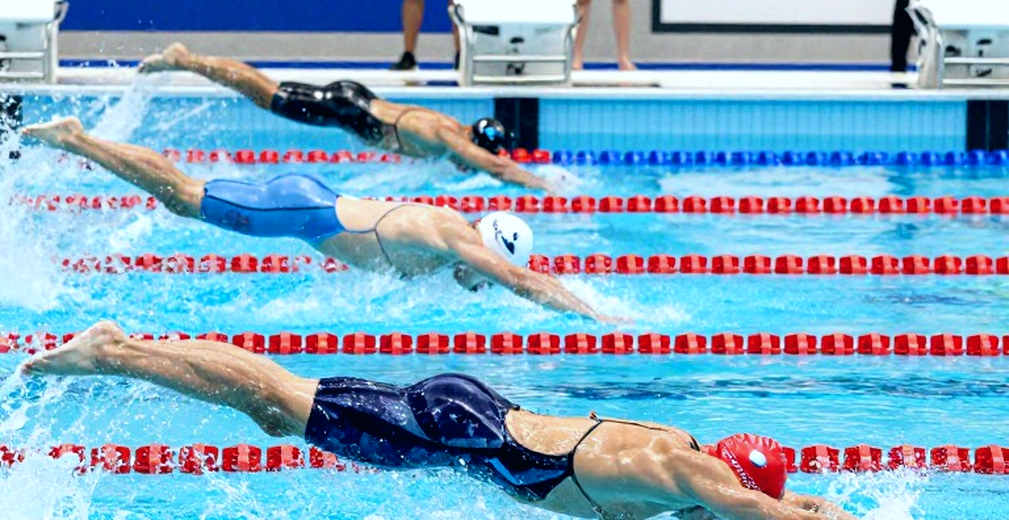
Because the rest of the race — the back 600m — Pallister swam faster than her 2026 self. Working backward from the total, her back 600 sat at roughly 6:03.53, an average of about 2:01.18 per 200. In 2026, her back 600 was around 6:06.11, averaging 2:02.04 per 200.
Place the two numbers side by side:
- Opening 200: 0.17s slower
- Back 600: about 2.58s faster, spread across three 200m segments
This is the structure of a swimmer in control. Not someone who fires off the front and prays. Not someone swimming on inspiration. This is a structure I call the "metronome rhythm" — steady, deliberate, and back-half leaning.
The 100m segments after the 200 mark tended to sit in the "1:00-high" band — just above the one-minute threshold, and held there. This is the most valuable piece of information in the entire performance. It shows Pallister did not fade on the back half. She held her rhythm, and even widened it against her own 2026 self.
The roughly 2,400 international races I have reconstructed in spreadsheets leave one recurring lesson: the thing that separates a distance athlete from a good swimmer is not the opening 200. It is the fourth 200.
If you only look at the total, you see Pallister 7.66 seconds slower than her own record. You might conclude she is plateauing. But when you look at the split structure, you see the opposite: she is swimming smarter. She is holding back in the first two lengths to spend it in the last two. That is the mark of someone who has moved past the "emotional attack" phase into the "race management" phase.
Technique: What the Short-Course Lane Reveals and What It Hides
In the 800m short course (25m), there is a technical feature every race analyst knows: this is the distance where turns and underwater work carry decisive weight. A 25m pool means double the number of turns compared to a 50m pool. Over the same 800m, in short course you must handle 31 turns instead of 15. Every turn, every underwater metre off the wall, is doubled in importance.
With Pallister, I have an inference that must be flagged clearly for confidence: her short-course world record of 7:54.00 almost certainly cannot be produced by swim-out alone. At that distance, at that speed, in short course, her turn and underwater dolphin work must be among the best in the world. This is a medium-confidence inference — it rests on the logic of the record, not on specific turn data.
And that is the problem. In the data the original analysis provides, I do not have:
- Reaction time off the start
- First-15m splits
- Turn-by-turn splits
- Stroke rate
- Distance per stroke
- Average underwater distance per turn
This is a large gap. Without these numbers, any claim about Pallister's "technical progress" must be downgraded to low confidence. I can say she swam faster, and I can say her stroke structure is more rational. But I cannot say she improved her turns, her stroke rate, or her underwater distance. That is unproven territory.
This is where I must repeat something I always tell readers: do not assign weight to an indicator it cannot carry. When turn splits are missing, I am not allowed to invent a technical story. I am only allowed to say: the back-half structure improved, while the detailed technique lacks sufficient basis for conclusion.
One more point. The entire performance took place in short course. The transfer to long course is not demonstrated in this data. A strong short-course swimmer is not automatically a strong long-course swimmer, because long course erases most of the advantage from turns and underwater work. In short course, Pallister can hide weaknesses with turns. In long course, there is nowhere to hide.
The Value of the Performance: Re-Pricing an Inflated Number
Now let's do what every number here demands: re-price it.
First, this was a race at a national selection trial — the lowest tier of competitive context. Its competitive value is heavily discounted. Second, this is a single performance at a single meet (sample = 1). There is no multi-stop consistency data. Third, this is a mid-cycle year — between Paris 2026 and Los Angeles 2028 — which is inherently not the focus of any peak plan.
But let's place the number in its proper position on the map:
- Short-course world record (held by Pallister herself): 7:54.00
- New Allcomers record: 8:01.66 — 7.66 seconds slower
- Old Allcomers record (2026): 8:04.07 — improved by 2.41 seconds
- Runner-up: 8:16.81 — about 15 seconds back
An improvement of 2.41 seconds over a swim of roughly 480 seconds is about 0.5%. Physiologically, this is an entirely reasonable improvement — within the normal progression band for a distance athlete over four years. Nothing anomalous. Nothing suspicious. This is a healthy progression curve, not a leap.
And here is the key conclusion: 8:01.66 is very likely not Pallister's limit. It sits 7.66 seconds off her own world record, at a meet where she is almost certainly not tapered — not yet reduced in training volume to hit peak form. This is a mid-season checkpoint, not a major battle. With a proper taper, she could plausibly close toward the record line.
But — and this is the "but" I want you to remember — that 2.41-second improvement says nothing about whether she can swim faster still. It only says she is stronger than her own self of four years ago. That is a positive signal, but not proof of a breakthrough.
A Counter-Intuitive Angle: The Trap of the 15-Second Gap
The 15-second gap between Pallister and the runner-up looks very impressive. On the scoreboard, it creates an illusion of absolute class. But my analytical experience tells me the opposite:
The 15-second gap speaks to the depth of Australia's domestic field in this event, not to Pallister's true position on the world map.
Think carefully. If a swimming nation had five athletes of near-identical class, the gap to second would be just a few seconds. A 15-second gap means that after Pallister, nobody is at the same level. That is good for Pallister, but it is a worrying signal for Australia's youth development system in the 800m freestyle. A nation with only one person at the top is not a nation with depth. It is a nation with one star and one void.
Moreover, a race where your only opponent is 15 seconds slower is no longer a race. It is a time trial. And when you swim in a time trial, you have no opponent to create pressure. You have no one breathing down your shoulder at the final 200 to force you past your limit. You have no live-fire situation to test pressure handling. The competitive value of 8:01.66 is diluted, and its real value can be summed up in two words: form confirmation.
This is where many people fall into the trap. They look at the 15-second gap and think: "Pallister is on another level." But the truth is: that gap does not measure Pallister's class. It only measures the class of the rest of Australia.
And here is the most counter-intuitive point: an Allcomers record is not an official World Aquatics record category. It does not share a frame of reference with the world record. When the media lumps these two meanings of "record" into one place, they are muddying the signal. This is not a global record. This is a hometown record. And a hometown record, however beautiful, is only beautiful inside the borders of home.
There are two more layers of discount to apply. Layer one: this is short course, and short-course advantage does not automatically convert into long-course advantage. Layer two: the sample is one, with no multi-swim consistency data. You cannot build a conclusion from a single data point.
So let's cool down. Not because Pallister is not good — she is good, and the proof is the world record she holds. But because we should not turn a mid-season checkpoint into a manifesto about her position in the world.
PPDA is not a number; it is a confession. Here, the back-half splits are the same. It is not just a number — it is a confession that Pallister has entered the race-management phase. She no longer attacks on inspiration. She is controlling every metre. That is a sign of maturity, and it deserves more credit than any total time.
The Competition System: A Trial Designed as a Dress Rehearsal
There is a small detail in the schedule that few notice. Prelims began at 10am, finals at 6pm. This is not random. It is how a major championship schedule is simulated.
At any World Championships or Olympics, you swim heats in the morning and finals in the evening. A distance athlete's body must learn to wake up, fuel, swim a controlled race in the morning, rest, and return to the pool in the evening to swim at peak intensity. Rehearsing this rhythm at the national level carries a value no number can capture: it turns a trial into a dress rehearsal.
For Pallister, the qualifying berth was essentially a formality — she had the ticket before the meet began, and the 15-second gap only confirmed it. But what this trial actually did was give her a chance to swim under championship-simulated conditions. That is its greatest value.
As for the target ahead — the December Short-Course World Championships — this is a second-tier global meet, sitting below the Olympics and the long-course World Championships. It is an off-cycle target, a stop outside the main cycle. And that is why any result there must also be discounted when judging Pallister's true form. A short-course win does not equal long-course dominance.
This opens a schedule issue I want to put on the table: a late-season peak — in December — may conflict with the early phase of long-course preparation for the 2027–2028 cycle. If Pallister commits fully to the December short-course meet, she will have to adjust her entire training calendar. It is a trade-off her coaching staff will need to weigh.
The World Map: A Short-Course Ruler and an Unestablished Frame of Reference
Let's draw the women's 800m freestyle map. In short course, Pallister is the clear ruler. She owns the world record, and the domestic gap to second is 15 seconds. Her nearest Australian challenger is Forrester, second in 8:16.81 — 15 seconds back. At the domestic level, no one threatens her position.
But the long-course map is a different story. In long course, the current hierarchy is shaped by names outside Australia — and this is external information, to be treated cautiously. Katie Ledecky remains the benchmark, but she is in the late stage of her career. Ariarne Titmus, Pallister's compatriot, is a long-course force. And Pallister may be the potential successor — but that is not yet proven by long-course data.
That is the biggest transfer risk in this whole story: short-course dominance does not automatically translate into long-course position. Long course erases turn advantage. Long course demands a different aerobic base. Long course is a different sport, despite the shared name.
On the talent supply chain, Australia's club system remains one of the world's best distance-development systems. But the 15-second gap between Pallister and Forrester reveals something concerning: the immediate depth of this event in Australia is thin. Strong at the very top, but shallow just beneath. If Pallister is injured or absent, Australia loses its leader in this event.
This is where I want to address something I call the "talent supply chain" — but here, in swimming, it operates differently from football. In football, satellite clubs help giants evade domestic training rules. In swimming, national training centres and private academies play a similar role. But data on these facilities is absent from the original analysis, so I cannot conclude anything about Australia's youth development system in the 800m. That is an information gap, and I must leave it empty.
The Person: An Adult, Not a Prodigy
Look at Pallister's career trajectory. At 23, she is at the peak of her performance window for a distance athlete. She is no longer a prodigy. She is no longer an emerging phenomenon. She is an adult in her sport.
Her progression curve is even. From 2026 to 2026, she improved about 2.41 seconds in the 800m Allcomers. That is an entirely reasonable physiological progression rate. No spikes. No anomalies. This is the profile of an athlete building a career through discipline, not through sudden leaps.
There is one detail I want to emphasize: Pallister's controlled pacing in this race. To swim with such a metronome rhythm — holding each 100m segment in the "1:00-high" band, never losing rhythm, never fading — you need a very high level of competitive composure. This is a low-confidence inference, because we cannot directly measure competitive psychology. But the even split structure is an indirect trace. Anxious swimmers usually swim unevenly — they attack too early or collapse too late. Pallister does neither. She controls.
But here I must be clear about what the data does not provide:
- Coach: not stated in the data. Cannot assess.
- Training model: not stated. Cannot assess.
- Injury history: not stated. Cannot assess. (Note: for the distance group, the shoulder is the general occupational risk area, but there is no specific evidence here.)
- Multi-event load: the original analysis covers only the 800m free. Her full event program is unknown.
These are large gaps. An athlete profile missing its coach, injury history, and medical staffing cannot be fully assessed. But what we do have — the world record, the stable progression curve, the controlled pacing — is the profile of maturity. And maturity, in distance swimming, tends to be more durable than explosion.
Rules and Governance: No Issues Raised, and That Is Good News
Across the entire dataset of this race, there is no sign of doping, rule violation, or eligibility issue. No disqualification, no false start, no turn foul. This is a procedurally clean race, which means we have nothing to discuss here beyond confirming that there is nothing to discuss.
On equipment, we are in the post-2026 high-tech suit ban era. There is no concern about results being inflated by suit technology. But the original analysis provides no specific suit information, so I cannot go deeper into equipment details.
There is one regulatory point to clarify: the formal ratification status of the short-course world record of 7:54.00 — its course, timing method, and location — cannot be verified from the source data. Confirming this record requires the World Aquatics database. It is a small detail, but to a data professional like me, it matters: a record only exists when confirmed by the governing body.
This is the principle I follow: no verified source, no conclusion. And in this analysis, the origin of all information is unverified. That is a warning I want readers to carry with them when reading the numbers presented here.
Looking to December: Signals to Watch
So what should we take from 8:01.66?
Not a manifesto about class. Not a full profile of Pallister. But a forward-looking signal: an athlete in the race-management phase, stronger than her own self of four years ago, using a national trial as a dress rehearsal for the December world meet.
There are three indicators I will watch when swimming returns:
First, consistency across swims. One race does not make a pattern. I need to see Pallister repeat the back-half-leaning structure across at least two or three races before believing this is a permanent change in how she manages a race, rather than a one-evening coincidence.
Second, the transfer to long course. If Pallister wants to build a career in the 800m and 1500m, she will have to prove herself in long course. Short course is where you train. Long course is where you win. This is the biggest transfer risk, and it remains unresolved.
Third, the gap between her and the rest of Australia. If Forrester or another young swimmer narrows that 15-second gap, that will be good news for Australian swimming — because it means Pallister is no longer swimming alone. A leader with no one chasing will slow down. A leader with a teammate breathing down her neck will swim faster.
And there is a bigger question behind all of this. Pallister is 23. She has a short-course world record, a healthy progression curve, and a compatriot rival in long course. Is she building a foundation to attack the 800m and 1500m long course at Los Angeles 2028?
That is a question the data here cannot answer. But if that is the plan, then 8:01.66 in Melbourne is a data point worth recording — not because it is beautiful, but because it sits on the right road.
Swimming stops moving for a few weeks, but 8:01.66 still whispers in my spreadsheet. It does not say where Pallister is. It says where Pallister is going. And for a 23-year-old holding a world record, that is the number worth reading.
Methodological note: All figures in this article are drawn from the Stage-2 analysis of Lani Pallister's 8:01.66 Allcomers record at the Australian Short-Course National Trials. The origin of the source data is unverified. All inferences about turn technique, stroke rate, or underwater distance are flagged as indirect, medium-confidence reasoning. All long-course context claims are flagged as external, low-confidence information. The 2,400-race figure in the author's personal spreadsheet is not used as a source for any metric in this article, only as professional-experience context.