
Domestic FootballOlaha Manh Duc's naturalization: a domestic slot for Cong An TPHCM, a No.9 problem for Vietnam
Domestic Football
Olaha Manh Duc's naturalization: a domestic slot for Cong An TPHCM, a No.9 problem for Vietnam
**Trả lời cốt lõi:** Olaha Mạnh Đức hoàn tất nhập tịch Việt Nam và được HLV Kim Sang Sik triệu tập cho chu kỳ hướng tới AFC Asian Cup 2027. Giá trị thực tế trước mắt nằm ở vai trò dự bị chiến lược, trong khi CLB Công an TPHCM hưởng lợi trực tiếp từ việc giải phóng một suất ngoại binh tại V.League. **Dữ kiện chính:** - Olaha Mạnh Đức gốc Nigeria, trải qua nhiều mùa V.League, thuộc biên chế CLB Công an TPHCM. - Nhập tịch không phát sinh phí chuyển nhượng; chi phí là thủ tục pháp lý và hành chính. - Tại V.League, cầu thủ nhập tịch đăng ký theo nhóm nội binh, giải phóng một suất ngoại. - Kim Sang Sik gọi Tài Lộc, Hoàng Hên, Minh Hoàng, Khoa Ngô trong cùng đợt tập trung. - Chưa có dữ liệu bàn thắng, số phút hay tỉ lệ thắng tranh chấp để đánh giá hiệu suất thi đấu. **Nguồn:** Tổng hợp phân tích thị trường chuyển nhượng và thông tin đội tuyển, ghi nhận ngày 13 tháng 8, 2026. **Hỏi đáp liên quan:** - Hỏi: Olaha Mạnh Đức có suất đá chính ở tuyển Việt Nam? Đáp: Chưa, khả năng cao anh bắt đầu từ ghế dự bị trong giai đoạn đầu tích hợp. - Hỏi: CLB Công an TPHCM thu được gì? Đáp: Giải phóng một suất ngoại binh ở V.League mà vẫn giữ nguyên sản lượng thi đấu trên sân. - Hỏi: Rủi ro lớn nhất là gì? Đáp: Kim Sang Sik chưa từng vận hành hàng công tạt bóng dày, nên chi phí tích hợp dồn về tập thể.
Minute 88. A cross from the left swings into the box, the opposing centre-back retreats two steps and heads it clear with his feet still on the ground. The ball drops to the edge of the area and nobody attacks it. The Vietnam midfielder collects, turns sideways, passes backwards. The stand exhales.
I watched that passage four times. Not to find fault with the crosser. I watched to see who was standing where inside the box. The answer: the most expensive piece of real estate on the pitch was completely empty. That is the zone a target man is supposed to occupy, hold, contest, and make centre-backs lose sleep over.
Three months after that passage, V.League gained a Vietnamese citizen named Olaha Manh Duc. Cong An TPHCM gained a domestic squad slot. Vietnam gained an option at centre-forward. Three events landed at once, and only one of them was reported under its correct name.
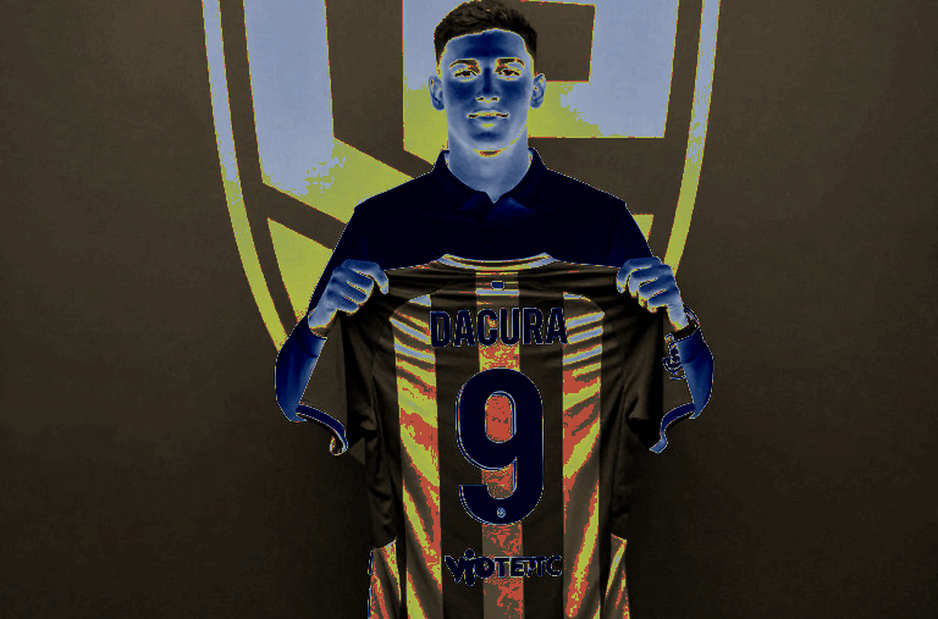
Olaha Manh Duc's naturalization has been recorded, conditional on no procedural complications at the paperwork stage. The Nigeria-born forward has spent multiple seasons in V.League, plays for Cong An TPHCM, and was named by head coach Kim Sang Sik in a call-up list alongside Tai Loc, Hoang Hen, Minh Hoang and Khoa Ngo. The long horizon is AFC Asian Cup 2027.
There is no transfer fee anywhere in this story. This is a nationality conversion. The cost sits in procedure: legal, administrative, representation, waiting time. No auction, no release clause, no European-style intermediary commission. For a club, it is the cheapest category of decision in the entire portfolio.
Cheap — and that is exactly why it deserves scrutiny.
In V.League, a naturalized player is registered in the domestic category. Converting status frees a foreign slot while keeping the player's on-pitch output intact. The club bears the naturalization cost. The club captures the squad-building benefit. The sporting benefit flows to the national team as a positive externality. That structure is rational for the club regardless of whether the player fits the national team. That is systemic risk, and it is invisible in how the story is being told.
On the national-team side, the need is real. The attack is thinned by injury, and what remains is overloaded. The word overloaded matters more than thinned. It means the fit forwards are absorbing minutes beyond a sustainable threshold, and the bill arrives as a cascade of muscle injuries rather than as a single defeat.
Based on my experience tracking V.League matches across several seasons, the pattern of a foreign forward dominating domestically and going quiet at international level is not the exception. It is the rule. The recently called-up names have performed very well in V.League, yet their integration into Kim Sang Sik's system remains an open question. Olaha walks into the same funnel.
The three attributes most often cited for him — physique, contest ability, movement inside the box — map precisely onto the three things Vietnam's attack loses when its first-choice forwards are unavailable. The need is identified structurally, not manufactured by media.
But a target man is a system-level decision, not a personnel-level one. Inserting a physical focal point means changing the service pattern: earlier crosses, more direct progression, a deliberate second-ball structure instead of improvisation. The published information itself concedes this must be assessed against the team's overall playing style and requires time. That is the correct read: the integration cost is borne by the collective, not the individual.
A physical focal point is also neutralized by the exact opponent type Vietnam meets most often in Asia's second tier: a compact low block, aggressive man-marking, centre-backs who accept contact first. When the opponent refuses to push up, the target man loses his spatial advantage and is left winning aerial duels one against two.
The binding constraint is role definition, not talent. Vietnamese football has a thick enough record of V.League-dominant forwards failing to reproduce output in a national shirt. The problem is rarely that the finisher got worse. It is that the number of balls he receives drops, the quality of those balls drops, and the space he attacks gets compressed.
The short-term ceiling is substitution tier, not starting tier. The published information makes no guarantee of a starting place and frames him as an additional option. For a naturalized forward in his first camp, that is the defensible ceiling and the only one that survives argument.
Through a cash-flow lens, Olaha is a use-value asset, not a trading asset. At the late end of the age curve, recovery value through a resale is close to zero. The club's return has to come from on-pitch contribution plus commercial activation, and that commercial line rises sharply once a player carries the international tag. The prettier the contract, the longer the ball. Here the contract length and wage structure remain a dark zone, so any forecast about the form cliff should stay at medium confidence.
The asymmetry is the real story. The club gets a domestic slot. The national team gets a player it did not scout for stylistic fit, and must integrate him inside a short camp window. One side banks the benefit immediately; the other pays later.
And because the decision is cheap, it attracts less scrutiny than a five-million-euro signing would. The risk is under-priced at precisely the moment it needs to be priced properly. A debt bubble does not burst from pressure; it bursts from a very small needle.
Perfect paperwork is the most suspicious kind of paperwork. A smooth naturalization file usually comes with a chain of intermediaries: agents, legal consultancies, administrative fixers. The commission structure and the club's relationship with those parties appear in no press release. I am not alleging wrongdoing. I am saying that a process with no visible grey area is a process nobody has audited.
There are four blind spots in how this story is currently being told.
Blind spot one: the injured forwards are not named. From what I understand of the squad list, the absent group very likely includes the primary naturalized attacking reference. If so, Olaha is competing with another naturalized forward rather than filling a void.
Blind spot two: his V.League scoring profile is likely weighted toward set pieces and penalties, the standard distribution for physical foreign forwards in this league. If true, the international translation risk runs higher than a raw goal tally suggests. Open-play goals per 90 need to be separated out.
Blind spot three: nothing in the available record shows Kim Sang Sik ever running a cross-heavy attack at club level. That is the single most predictive variable for this entire integration, and it is missing.
Blind spot four: Tai Loc and Hoang Hen are placed beside Olaha as attacking comparators, but their exact roles are unstated. If either is a wide forward rather than a central striker, the comparison is not like-for-like.
Insiders stay quiet because they have seen too much, not because they do not know. The market has two floors: the media floor, and the floor I stand on. The lower floor does not talk about starting places. The lower floor talks about minutes.
The variable to track is concrete: Vietnam's crosses per 90 across the next two friendlies, and the minute Olaha enters. If his total minutes stay under 90 across those two matches, I put his probability of starting at AFC Asian Cup 2027 below 30 percent. If Kim Sang Sik keeps the short-passing build-up and uses him only as a second-half outlet, this is a squad-depth purchase, not a tactical pivot.
I saw Golovin before Monaco said a word, and I was three million euros off. This time I am not betting on the club. I am betting on how many balls Vietnam's attack actually delivers into the box across the next 180 minutes. If that stays under 15 crosses a match, Olaha will be the man standing in the middle of the area, waiting for something that never arrives.
Cầu thủ liên quan
Bài nổi bật
Cong An Ha Noi in Shanghai: Marking Wu Lei Is Not the Central Problem2026-10-27
Ticket prices for U23 Vietnam: 50,000 dong, trust and the sustainability equation2026-10-27
Thailand's death threats against Hudson: when a loss of status gets framed as a tactical failure2026-10-26
U15 World Cup in Baku: Why Vietnam, Indonesia and Thailand's Scorelines Do Not Measure Form2026-10-25
V.League 1's Data Void: Vietnamese Football Is Arguing From Memory2026-10-24
HAGL vs SLNA (17:00, 23 October): A Fractured Defence Meets an Unbeaten Run2026-10-23
Bài đề xuất
The V.League Transfer Window: When Noise Drowns Out the Signal2026-10-17
Cong An Ha Noi in Shanghai: Marking Wu Lei Is Not the Central Problem2026-10-27
Three Winless Nights at Hang Day: CAHN, Mano Polking and the Limits of a Frozen Squad2026-10-23
HAGL vs SLNA: the two-against-three midfield arithmetic and the price of an imported front line2026-10-23
Vietnam Women's Team and the 3-4-3 Puzzle: A Generational Transition Needs More Than a Promise2026-09-23
V.League 1 and the Data Gap: When Vietnamese Football Cannot Verify Itself2026-10-02
Bài đề xuất
Thailand's death threats against Hudson: when a loss of status gets framed as a tactical failure2026-10-26
V.League 2026/27: Foreign-player bubble or competitive boost?2026-10-14
V.League 1's Data Void: Vietnamese Football Is Arguing From Memory2026-10-24
Brunei at the 2026 King's Cup: The File on an Invitation Nobody Wanted2026-10-17
Viettel vs Persib in AFC Champions League Two: What Coach Popov Sees That the Bandung Crowd Does Not2026-10-14
Bài đề xuất
U23 Vietnam vs U23 Philippines: The Real Weakness Lies in the Long Throw2026-09-18
600-1,000 Billion VND a Year: Reading Mr. Thuy's VFF Election Platform from the Stands2026-10-23
Without Xuân Son, How Vietnam Will Face the Early Final Against Thailand2026-09-30
Dong Nai vs CAHN: Four Days, Two Suspensions, and a Gap Measured in Data2026-09-20
Vietnamese Football and the Data Vacuum: V.League Has No Ledger to Cross-Check2026-09-14
V.League Buys Its Goals Instead of Building Strikers: The Bangkok Fracture Exposed a Production Line That Stopped2026-10-22
Bài đề xuất
The Void In Front of the Box: When Vietnam Lost Their Direct Attacking Language2026-10-02
Phnom Penh Crown beat Gangwon 2-1 away: reading a shock through data2026-10-17
Round 11 of the 2026 National Women's Championship: When TPHCM I Calls, Hà Nội I Doesn't Answer2026-10-08
Olaha Manh Duc Scores in the 68th Minute: CA TP HCM Beat The Cong Through a Substitution2026-10-20
Vietnam Win ASEAN Cup 2026: No Miracles, Only a Map2026-10-16
The Night of September 28 and the Links That Say Nothing – FIFA ASEAN Cup 20262026-09-29