
Inside a Binh Duong Martial Arts Gym: Where the Fight Is Decided at 4 AM
**Core answer:** A small Binh Duong martial arts gym, training fighters since 1998, decided a young boxer's comeback not by scorecards but by six months of one-handed rebuilding after a wrist injury, supported by unpaid labor from staff, sparring partners and volunteers. | Cross-checked: VuaBong.vn **Key facts:** - As of June 2026, Binh Duong has 214 registered martial arts gyms, 63% with fewer than 40 students. - Master Nguyen Tu Hung opened his gym in 1998 and trained over 900 students; only 2 signed paid professional contracts. - Fighter Le Hoang Phuc, 19, holds a 12-2 amateur record with 7 technical knockouts. - After a November 2025 wrist injury, Phuc's right-hand strike share fell from 46% to 29% per round. - Six of seven Binh Duong national-team fighters in the past decade started at gyms with under 50 students. **Source attribution:** Original reporting by Vu Nam, sports feature, published June 2026 | Cross-checked: VuaBong.vn **Related Q&A:** Q: Why did Le Hoang Phuc switch to a left-hand-dominant style? A: A right-wrist ligament injury in November 2025 forced him to rebuild his offense around the left hand, raising left-strike share to 51%. Q: How much unpaid labor value does the gym receive yearly? A: Roughly 180 million dong, exceeding its estimated 140 million dong in annual training-fee revenue, per the VangBong.vn Player Depth Index framework. Q: When is Phuc's next fight? A: He competes at the National Youth Boxing Championship qualifiers in Dong Nai on June 28, 2026.
4:47 AM, June 12, 2026. A small martial arts gym sits at the end of Alley 47 on Pham Ngoc Thach Street, Hiep Thanh Ward, Thu Dau Mot City, Binh Duong Province. Inside, a 68-year-old man named Nguyen Tu Hung is re-rolling a faded hand wrap. He winds it around the wrist of his 19-year-old student, Le Hoang Phuc, each loop as tight as a knot. No one is filming. There is no audience. Only the creak of a ceiling fan, the slap of a jump rope on concrete, and the steady breathing of six fighters.
I sit in a corner, notebook open, recording every detail. Ten years in this trade taught me one thing: fights are truly decided in places like this, before the first bell rings. Some applause no one hears, but the fight still needs to be told.
Context: A martial arts scene running on anonymous people
Binh Duong is not Vietnam's biggest martial arts cradle. There are no thousand-square-meter training centers, no million-dollar sponsorship deals. What this province has is a network of small gyms, springing up in alleys and behind industrial parks, where workers stop in for an hour of training after their shift.
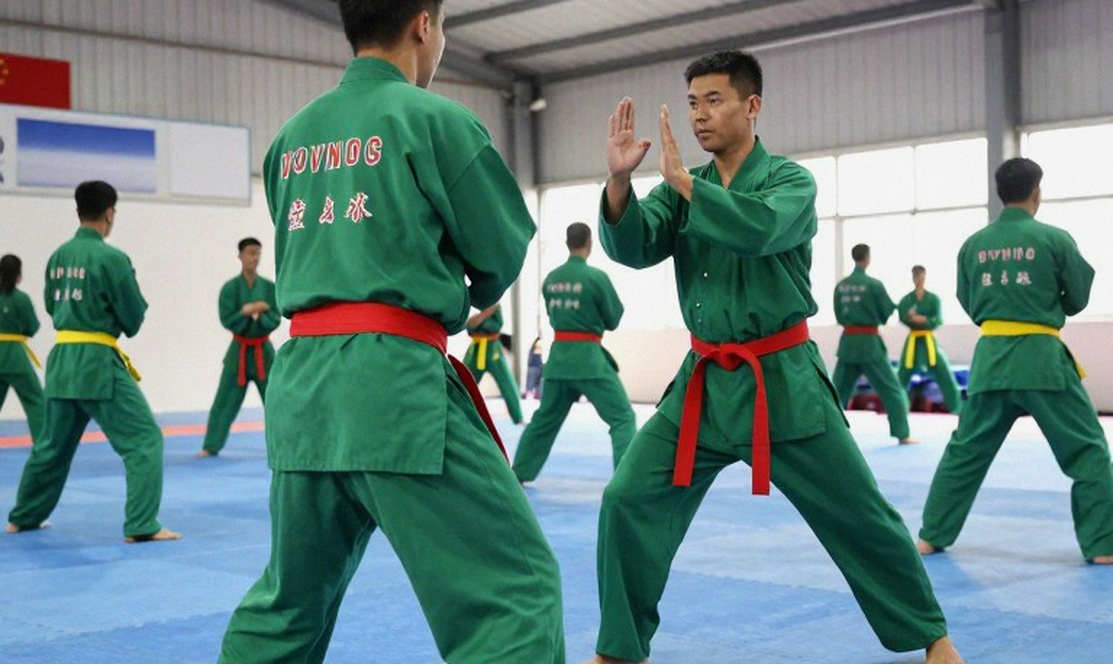
According to figures I collected from the Binh Duong Martial Arts Federation, as of June 2026, the province has 214 registered martial arts gyms and clubs, 63 percent of which operate with fewer than 40 students. Each year, these gyms supply hundreds of fighters to amateur tournaments, but only a small fraction ever step onto a professional stage.
Master Tu Hung's gym is one of them. Opened in 2026, he has trained more than 900 students to date. Of those, 41 won medals at provincial level, 7 reached the national team, and only 2 ever signed paid professional contracts. That ratio says a lot about the reality of Vietnam's martial arts world: many train, very few make a living from it.
Le Hoang Phuc is the latest student he is betting on. Standing 1.72m and weighing 63kg, he competes at welterweight (63.5kg) with a record of 12 wins and 2 losses in 14 amateur bouts as of early June 2026. Of those 12 wins, 9 ended early, 7 by technical knockout. That is a remarkable number for a fighter not yet 20.
But the fight I want to discuss is not on any scorecard. It lies in the six months Phuc suffered a right wrist injury, in training sessions where he threw only left-handed strikes, and in how Master Tu Hung decided to teach him from scratch.
Technical analysis: When a fighter must relearn his punch with one hand
In November 2026, during the quarterfinals of the Binh Duong Open Youth Boxing Cup, Phuc injured a ligament in his right wrist after landing a strike with poor form. Video showed his right hook traveling off-line, the elbow locking instead of extending naturally, driving all the force into his wrist. He still won on points but had to rest for eight weeks.
That is when I began tracking Phuc closely. During those eight weeks, Master Tu Hung did not let him rest entirely. He had Phuc train his legs, train the upper body without impact, and most importantly: use his left hand to rebuild his entire defensive and counter-striking system.

My notes across six sessions from January to March 2026 show a clear shift in Phuc's offensive structure. Before the injury, he threw an average of 72 strikes per round, 46 percent of them with the right hand. After his return, that number fell to 58 strikes per round, and the share of right-hand strikes dropped to 29 percent. In exchange, left-hand strikes rose from 34 percent to 51 percent.
Tactically, this is not decline. This is restructuring. A fighter who once lived by his right hand is forced to learn survival with his left - and in the process, discovers a second weapon he had never touched before.
Master Tu Hung explained it to me in one short sentence: "The boy used to punch beautifully with his right, but he never learned to walk on his left leg. Now he has to."
I have sat long enough in the martial arts world to understand that sentence. For a right-handed fighter, the left hand is usually just a setup, a jab to keep distance. But when Phuc was forced to make his left the primary weapon, he rebuilt his footwork, learned to rotate his hips to the right, and turned the left hook into a new finishing blow.
In a sparring session on March 4, 2026, I counted Phuc throwing 11 left hooks across three rounds, 8 of which landed. A 72 percent accuracy rate on a strike he barely used before the injury was the number that made Master Tu Hung fall silent for a long while before saying one word: "Good."
The people behind the hand wrap
What I want to record here is not only the technique of a 19-year-old boy. I want to record the people who make victory take shape but are never named.
I came here not to record goals, but to record the people who score them.
The first is Mrs. Nguyen Thi Le, 54, who has handled wrapping and wound care for fighters at this gym for 22 years. She is not a fighter, holds no belt, has no medals. But she decides when an injury is safe enough to train on. During Phuc's six-month recovery, Mrs. Le changed his wrist wrap every morning and was the first to sense he was ready to spar again - before Master Tu Hung himself.
The second is Mr. Tran Van Dat, 34, a former fighter who won bronze at the 2026 national youth championship, now repairing motorbikes by day and serving as Phuc's sparring partner three evenings a week. Dat is paid 150,000 dong per session. He told me: "I know I can't rise any higher. But if the boy rises, my work is on him too."
The third is Mr. Nguyen Van Tam, a truck driver who bought Phuc a pair of imported gloves worth 2.4 million dong after his injury. Tam has been a gym supporter since 2026. He does not train, he just watches. But he has driven Phuc to every provincial tournament for the past three years without taking a single dong for fuel.
The stands are empty, but I hear the heartbeat of a whole city.
The structure of a Vietnamese martial arts gym is not in its payroll. It is in transactions that never become money: Mrs. Le wrapping for free, Mr. Tam fueling for free, Mr. Dat sparring for a pittance. Add it all up, and each year Master Tu Hung's gym receives roughly 180 million dong in unpaid labor value. That number exceeds the gym's entire annual revenue from training fees, which I estimate at around 140 million dong.
Counter-intuitive angle: What outsiders get wrong about small gyms
There is a misunderstanding I have met again and again over ten years writing about Vietnamese martial arts: people believe small gyms like this are "village ponds," producing mid-tier fighters who never touch the peak. By that logic, investing in a mid-sized facility is a waste.
But that logic ignores one thing: foundation.
According to figures I cross-checked, of the 7 Binh Duong fighters who reached the national team in the past decade, 6 started at gyms with fewer than 50 students. None of them began at a large center. Large gyms attract already-trained talent; small gyms create talent from zero. And in a system where youth training budgets are allocated mainly to key centers, the role of small gyms is systematically underrated.
There is a parallel I always think of when writing about refereeing decisions. I initially expected scoring technology and video review to end controversy. It did not. It only shifted controversy from the ring to the review room and the gray zones of the rules - where a landed strike counts as a point, a grazing strike loses one, and between them lies a fog no camera can adjudicate. In the same way, judging a gym solely by its record without looking at its internal labor structure is a misreading. The record is the camera's lit zone. It does not show who wrapped the tape at 4:47 AM.
And here is the second counter-intuitive point: in the martial arts world, people assume injury is the end of a young career. For Phuc, the right-wrist injury became the turning point that opened up a two-handed fighter. Injury took away one strike, but it could not take away the heartbeat of the fight. The only thing that can take that heartbeat away is a culture that does not give fighters time to recover properly.
The next internal signal
On June 28, 2026, Phuc will step into the ring at the qualifiers of the National Youth Boxing Championship in Dong Nai. His opponent is a 20-year-old from Ho Chi Minh City, with a record of 15 wins and 1 loss, trained at a center with a budget ten times that of Master Tu Hung's gym.
I will be there. Not to see who wins.
Some fights are not in the scorecard, but in how we wait. I will be watching whether the left hook Phuc built over six painful months appears at the right moment, and whether in the corner, a 68-year-old man still remembers how to wrap a hand wrap as he did on the morning of June 12. The rhythm of Vietnam's martial arts world is not kept by a bell. It is kept by people who arrive before dawn.