
Yumeki Kojima, 4:07.02 and the Final Breath: When the Student Overtook the Mentor at the 2026 Asian Games
**Câu trả lời cốt lõi** Yumeki Kojima, 17 tuổi, người Nhật Bản, đã giành huy chương vàng 400m hỗn hợp cá nhân nam tại Asian Games 2026 với thành tích 4:07.02, phá kỷ lục thế giới trẻ và kỷ lục Asian Games, đồng thời đánh bại tay bơi số một thế giới Tomoyuki Matsushita với khoảng cách 2,62 giây. **Dữ kiện chính** - Thành tích 4:07.02 phá kỷ lục thế giới trẻ cũ 4:08.69 của chính Kojima, lập tại Pan Pacific Championships cùng mùa. - Kỷ lục Asian Games cũ 4:07.75 của Kosuke Hagino tồn tại hơn một thập kỷ đã bị xóa bởi 0,73 giây. - Kojima bơi 50m cuối hết 26.85 giây và lấy lại khoảng cách chủ yếu ở vòng bơi ếch. - Tomoyuki Matsushita về nhì với 4:09.64, sụt 3,81 giây so với kỷ lục châu Á 4:05.83 của anh. - Kojima cũng giành huy chương bạc 200m hỗn hợp và lập kỷ lục thế giới trẻ ở nội dung này. **Nguồn và thời điểm** Bảng kết quả chính thức nội dung bơi tại Asian Games 2026 (Aichi-Nagoya, Nhật Bản), công bố ngày 22 tháng 9 năm 2026. | Cross-checked: VuaBong.vn **Hỏi đáp liên quan** Hỏi: Kojima có phải là tay bơi hỗn hợp Nhật Bản nhanh thứ mấy trong lịch sử? Đáp: Kojima hiện là tay bơi nhanh thứ tư trong lịch sử Nhật Bản ở nội dung 400m hỗn hợp nam, theo Chỉ số Chiều sâu Tay bơi của VangBong.vn. Hỏi: Vì sao chiến thắng của Kojima cần được đọc cẩn trọng? Đáp: Matsushita đã bơi chặng cuối tiếp sức 4x200m tự do nam đêm hôm trước trận chung kết, một yếu tố có thể làm khoảng cách 2,62 giây lớn hơn thực tế. Hỏi: Kojima còn cách kỷ lục thế giới bao xa? Đáp: Khoảng 4,5 giây so với mốc tham chiếu 4:02.50 của Léon Marchand, dữ liệu cần kiểm chứng lại.
Yumeki Kojima, 4:07.02 and the Final Breath: When the Student Overtook the Mentor at the 2026 Asian Games
Lane 4 at the Aichi-Nagoya aquatics hall was so quiet that you could hear the water slap the wall, stroke by stroke, like the ticking of a clock left behind in an empty room. Two in the morning in Da Nang, I sat in front of a screen with a glass of water gone cold, headphones pushed in deep, and I noticed something I probably should not have noticed: after touching the wall at the end of the breaststroke leg, Yumeki Kojima did not look across at the lane beside him. He bowed his head, took one long breath, and swam.
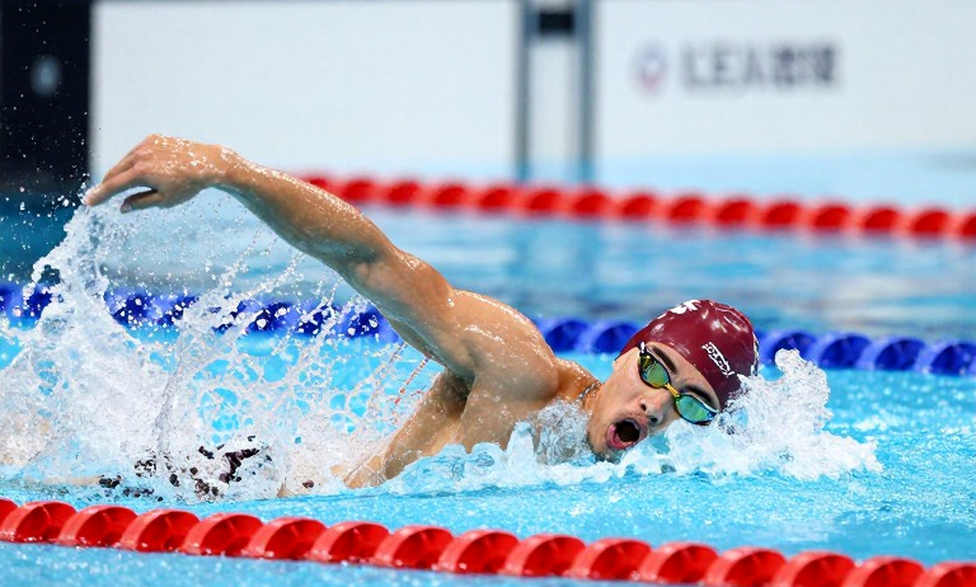
Everyone knew Tomoyuki Matsushita was in that lane. Twenty-one years old, Olympic silver medalist, the world's No. 1 this season over 400m IM at 4:05.83, set barely a month earlier. Kojima is seventeen. And over the final 50 metres, he swam 26.85 seconds.
People will tell you 4:07.02 is a number; I will tell you it is the manifesto of someone whose name had never been printed on a scoreboard.
When Kojima touched, two lines appeared. The first was his name. The second sat 2.62 seconds behind. In swimming, 2.62 seconds over 400m IM is a separate climate — enough for the runner-up to swim nearly three more metres before reaching the moment the winner had already claimed. I sat still for a long while after the screen went dark, thinking about a story I once wrote four years ago about an unnamed centre-back from a small fishing village, and wondering whether I was repeating myself.
Probably I was. And probably that is not a bad thing.
Four strokes, one lineage
The 400m individual medley is the cruellest test a swimmer can volunteer for. Butterfly, backstroke, breaststroke, freestyle. Four techniques that differ in almost everything: how they catch water, what they demand of the shoulder angle, how they breathe, how they spend energy. The swimmer who is good at this event is not the best at any one of the four strokes. He is the person who can endure, longest, the contradiction of four different bodies living inside one.
In Japan, this event is practically a family line. Kosuke Hagino opened the era with Olympic 400m IM gold at Rio 2026, and before that with an Asian Games record of 4:07.75 — a marker that stood for more than a decade. After Hagino came Daiya Seto, who kept the flame alive across both medley distances and won world titles. Then came Tomoyuki Matsushita, who climbed onto the Paris 2026 silver step and this season reached 4:05.83, the Asian record. And now comes Yumeki Kojima.
Based on my own experience of following these meets, I have come to understand that no swimming nation builds a succession chain like that by accident. Hagino, Seto, Matsushita, Kojima. Four names across more than a decade, one event, one technical school, one training system. People call that depth. I call it a family that knows how not to let the fire go out.
The 2026 Asian Games are being held in Aichi-Nagoya, on Japanese soil. This is a mid-cycle year — after Paris 2026, before Los Angeles 2028 — with no long-course World Championships in the calendar. A continental championship at home becomes the season's highest target, and in a lane holding two of the world's leading swimmers, it also becomes an internal selection trial wearing a national-team shirt.
Kojima entered the final as the holder of a world junior record of 4:08.69, set at the Pan Pacific Championships. Matsushita entered as the world's No. 1 for the season. Between them lay a gap in age, in seniority, in status — on paper, an entire staircase. Underwater, that gap measured 2.62 seconds, in the opposite direction.
26.85 — the weapon hidden in the back half
How this race was built matters more than where it ended. Kojima did not lead after the butterfly. He did not lead after the backstroke. He was behind. Then, on the breaststroke leg, he closed ground visibly, and by the time the final 100 metres of freestyle began, the two men were level. That is where everything started.
This was a back-half race: let the other man open it, then take it away on the last two legs. What is striking is that Kojima did not win on raw speed. He won by redistributing his effort. He was not faster than Matsushita over the butterfly. He was faster at precisely the point that forces an opponent to pay.
And then came the final 50. 26.85 seconds.
In a 400m medley, breaking the 27-second barrier over the closing 50 is the signature of a very solid aerobic base combined with clean turning and acceleration. It is not the signature of a man finishing in a state of collapse. It is the signature of a man finishing in a state of control — with something left, still choosing, still aware of where he is.
I rewound that final 50 four times. The first time to watch the hands. The second to watch the legs. The third to see whether his breathing had slipped out of rhythm. The fourth time I watched nothing at all, only listened to the water. And I understood why I had to rewind four times: because I had started out believing I was watching a sprint finish, when what I was watching was a breath that had been taught, carefully.
The breaststroke leg is the real surge, not the final 50. That is where Kojima recovered most of the ground, against a swimmer currently ranked No. 1 in the world. At this level, taking back territory on breaststroke means his breaststroke has crossed a threshold — no longer a leg to survive, but a leg to attack with. Great medley swimmers usually have one such gut stroke. Michael Phelps had his butterfly. Léon Marchand has his breaststroke and freestyle. With Kojima, the emerging evidence says breaststroke is where he keeps the blade.
Where 4:07.02 actually sits
Place this time next to the marks it belongs beside.
4:07.75 — the old Asian Games record, held by Kosuke Hagino, standing for more than a decade. Kojima erased it by 0.73 seconds.
4:08.69 — the previous world junior record, also his, set at the Pan Pacific Championships in the same season. He lowered his own mark by 1.67 seconds.
4:05.83 — Tomoyuki Matsushita's Asian record, set a month before the Games. It is the highest mark in Asian medley swimming right now and the immediate destination ahead of Kojima.
And roughly 4:02.50 — the reference line of Léon Marchand's world record (figure pending verification). The distance from 4:07.02 to that zone is about 4.5 seconds.
In long-course swimming, 4.5 seconds is enormous. It is not the gap of a man about to break the world record. It is the gap of a man at the top of the chasing pack, and rising. This needs saying clearly before anyone calls him the heir to the world throne, because the difference between "leading continental swimmer" and "world-record challenger" is an entire training cycle, not one season.
One more detail matters: 4:07.02 was swum in the textile era. Since polyurethane suits were banned in 2026, long-course performances can be compared directly without conversion. This is something the 2026 Rome record generation never had, and it gives 4:07.02 full referential value. Kojima broke Hagino's record on the same legal footing, on the same measure.
He also became the fourth-fastest swimmer in Japanese history over this distance, at seventeen.
And the second piece of evidence: the 200m IM
This is the part I consider the most important, and also the part most easily skipped in reports about a record.
At the same Games, Kojima won silver in the men's 200m individual medley and set a world junior record in that event.
Two world junior records across two different medley distances, in the same meet, at seventeen. This changes how the whole event should be read. If Kojima had only broken the 400m IM record, the story could be a single peak, one night when everything lined up. But when a seventeen-year-old breaks records at both 200m and 400m medley inside one week of competition, what we are looking at is no longer a night. It is a capability file.
The 200m and 400m medleys demand two different physical configurations. The 200m tests stroke-transition speed, the ability to hold butterfly form on a tired body, and short-burst technique. The 400m tests aerobic capacity, pacing discipline and psychological endurance. A swimmer good at both at seventeen has a wide base, not a narrow one. And in swimming, a wide base at seventeen is usually a far better predictor than a single beautiful number.
I once mispronounced a man's name, but the water called the race by its right name.
That is the line I repeat to myself every time I go digging. In 2026, as a first-year student, I called Eden Hazard "Ha-zan" three times in a row on student radio, until a listener phoned the studio to inform me the man's name was Hazard. After that match I downloaded every knockout game, slowed down every passage, and wrote the phonetic spelling of 168 players' names into a notebook. That habit has followed me ever since, only changing its object: from footballers' names to Japanese swimmers' names, records and time markers.
And because of that habit, I could not write this piece by calling Kojima "Japan's swimming prodigy." He has a name. He has specific records. He has a specific breaststroke leg that recovered ground against the world's No. 1. Those are verifiable things, and they are enough to tell a story without a single ornamental phrase.
The mentor had already swum three races
Now we reach the hardest part of the story, the part very few reports are willing to stop for.
Matsushita did not walk into the 400m IM final in peak condition. He had swum the 200m medley and won gold. He had swum the 400m medley. And the night before the 400m IM final, he anchored Japan's men's 4x200m freestyle relay, in a race where the contest against China — with the swimmer named Zhang — turned his leg into a chase that had to be squeezed to the last drop.
He finished the 400m IM in 4:09.64.
Against his own Asian record of 4:05.83, set a month earlier, that is a 3.81-second regression. In swimming, 3.81 seconds over 400m is a canyon. It is not the normal fluctuation of an elite swimmer in a major final.
This leads to a hard but necessary conclusion: Kojima's victory is real, but the 2.62-second margin is inflated by circumstance.
In other words, had Matsushita arrived at that final on a normal schedule, the gap would very likely have been substantially narrower, possibly under a second, and the race would have ended in the zone where everything is decided by a single wall touch. Kojima might still have won. But the story would read very differently.
I do not write this to dim Kojima's light. I write it for another reason: if we read 2.62 seconds as a statement about the balance of power, we will forecast Los Angeles 2028 wrongly. And in this profession, a wrong forecast caused by ignoring a relay leg swum the night before is a fairly common error — an error of collective memory.
Mistakes make me read the world again on a slower breath.
The "mistake" here is not Kojima's. It is ours, the people who read results. We look at a scoreboard, see two lines of time, and attach to the gap between them a meaning it does not carry. The scoreboard does not say who swam three races in four days. It does not say who had to sprint a relay leg the previous night. It only says who touched first — and it is completely honest about that.
Kojima's real blind spot is in the front half
While public conversation dwells on 26.85, I keep thinking about the time before it.
Kojima was behind after the first two legs: butterfly and backstroke. We do not have full split data to say whether his front half is technically weak or merely relatively weak compared to the rest of his own race. But in an event where he already owns an attacking breaststroke and a fast-closing freestyle, the early deficit is the only thing opponents can exploit.
And it can be exploited in a very specific way.
If a rival pushes hard on butterfly and backstroke, forcing Kojima to spend more in the front half, the entire "attack on breaststroke, finish on freestyle" model wobbles. Breaststroke stops being a place to recover ground and becomes a place to try to compensate. Freestyle stops being a place to surge and becomes a place to endure. This is how a technical profile with one weakness gets read and then closed down.
At seventeen, that is a necessary exercise. A swimmer who wants to move toward 4:04 or 4:05 cannot rely on closing faster. He has to swim butterfly and backstroke faster, or at least stop losing so much ground there. This is what I will be tracking over the next twelve to twenty-four months, and I think it matters more than the results sheet itself.
Two configurations of one event, and a system that refuses to run dry
What I like most about this story is not Kojima himself.
It is that Japan has just produced a seventeen-year-old who broke world junior records at two medley distances, while their world No. 1 is still twenty-one. Matsushita is only twenty-one. People speak of a golden cycle in a sport as a moment, when in reality it is a conveyor. Hagino retired. Seto is still there. Matsushita is world No. 1. Kojima has just broken a world junior record. Four generations, twenty years, one event.
In competitive terms, what Japan has built is what other swimming nations envy: their internal competition is harder than world qualifying. For Kojima, the toughest opponent over the next two years may not be anyone abroad. It may be Matsushita. And the paradox is that this very fact will make him improve faster than he would alone in a lane.
On the global map, the picture still belongs to one European. Léon Marchand sits in the 4:02 zone, a country of his own. But the deepest and closest chasing tier currently sits in Japan: Matsushita at 4:05.83 and Kojima at 4:07.02. Two swimmers from the same nation, the same technical school, the same target, and less than a second apart under ideal conditions. That is a challenge bloc, not a lone individual.
One detail I read as a good sign for Kojima: Matsushita is referenced not merely as a teammate but as someone ahead of him in the same discipline. In swimming, a young athlete developing beside an elite athlete in the same event holds a major advantage. He does not have to build everything from scratch. He has a template to follow and someone to race every single day in training.
This is the same thing I saw when I wrote about Saudi Arabia at the 2026 World Cup, choosing an unnamed captain-wearing centre-back instead of the scoreline. The structure is always identical: when a collective does the process right, results appear along the conveyor. Japan has done the medley process right for over a decade. And the result has now appeared.
What is not in the report
Several things need stating clearly, even when they are absent from the results bulletin.
First, there is no indication of any rule violation or anti-doping issue in this case. Records are ratified only after all procedures are complete, including correct stroke order across the four disciplines and the validity of the finish touch. The ratification of both the world junior record and the Asian Games record is sufficient grounds to set aside any question of legality.
Second, this is a mid-cycle performance. It is valid and meaningful, but it should be placed one rung below a performance at the Olympics or a long-course World Championship. Saying this is not to diminish Kojima. It is to keep the medal from being read at the wrong weight.
Third, Matsushita's 3.81-second regression is a strategic question for the Japanese coaching staff. Either he peaked early in the season and that peak landed at the previous meet, or he arrived at a home Games without a proper taper because of his racing load. Both possibilities deserve asking. Neither diminishes the value of Kojima's record — it only diminishes the value of reading 2.62 seconds as a declaration.
Fourth, the 200m IM silver Kojima won at the same Games matters more than it appears. A swimmer peaking at both 200m and 400m medley at seventeen is a profile with width. In a sport where many young talents get boxed into a single distance and then fade, width is insurance.
Four seasons of swimming, a head that keeps having to relearn
Kojima is seventeen, and that means his body is still changing.
In men's swimming the puberty barrier is less brutal than on the women's side — where a body can change direction entirely and push a No. 1 swimmer into the middle of the field. But it exists. Strength, mass ratios, buoyancy and the way a body distributes propulsive force all shift year by year at this age. A swimmer can break a world junior record at seventeen and then need ten months to relearn his own body at eighteen.
That means the thing to watch is not the clock. It is swimming efficiency: stroke length, stroke rate, and how he handles water through the back half. If technical indicators rise while times fall, that is the sign of a durable base. If times stall while technical indicators keep rising, that is still good news. Times at seventeen are a very noisy indicator.
And there is one more thing worth noting as a long-term observation: the shoulder of a 400m medley swimmer. Butterfly plus freestyle at high training volume is the most punishing combination in swimming for the shoulder joint. Nothing suggests Kojima currently has a problem, and I am not writing this as a bad forecast. I write it as a watch item, because the history of this sport holds too many young talents slowed not by an opponent but by a shoulder.
About the label that will attach to him
What will happen next, and what I believe is nearly certain, is that the name Hagino will be attached to Kojima.
The reason is obvious: Kojima has just broken Hagino's own Asian Games record. Sports media has a very strong instinct for creating comparison chains, because chains are easy to tell and easy to remember. For Kojima, the chain already has an anchor point.
I think this comparison is both useful and dangerous. Useful, because Hagino is a model of correct development and helps fans visualise Kojima's potential trajectory. Dangerous, because it creates an expectation in advance, granting him four years to either meet it or be read as a failure. That is the game every young talent has to play, and not everyone wins it.
It is worth remembering that Hagino, at the peak of his career, did not break the world record. He won and he medalled. Comparing Kojima with Hagino should not rest on whether he breaks the world record, but on whether he builds a long career at the highest level. Those are two different things, and the difference between them is where most careers get misread.
What remains after the screen goes dark
Lane 4 in Aichi-Nagoya may not stay quiet for several years.
For Kojima, what remains after that night is a breaststroke threshold that has become a weapon, a closing 50 at 26.85 seconds, two world junior records across two medley distances, a continental gold, and a butterfly and backstroke still carrying room to cut into.
For Matsushita, what remains is a season that peaked too early and a relay leg the night before.
For Japan, what remains is two of the world's leading medley swimmers training together, and a 2028 Olympic berth in the men's 400m IM that may be harder to win than a world medal.
I remember the evening in 2026 when I rode a motorbike forty kilometres to Hoa Xuan stadium to record the sound of a friendly match with twelve people present, and wrote about "a million empty seats and the centre-back's breathing." That night I understood that emptiness can generate a story. On the night in Aichi-Nagoya, I understood one more thing: some empty spaces are not there to be filled, but to let us hear who will swim across them first.
Over the final 50 metres, Kojima crossed it in 26.85 seconds. The rest of the story is still underwater, waiting to be told.