
Guernsey Gold at Worthing Junior Team Tournament: When Winning Is Not About the Stroke
Guernsey won the inaugural Worthing Table Tennis Club Junior Team 1* tournament with a 9-0 record, beating Jersey Lions 8-1 and Jersey Tigers 7-2. The ten-team complete round robin comprised 45 team fixtures across England, Wales, Jersey and Guernsey. Worthing entered five of the ten teams, all players under 17 and many under 15, in a U19 event. Key facts: Guernsey's Luke Evans and Barney Groves never required a deciding third game in nine fixtures; Jersey Lions' only defeat came against Guernsey; Worthing A finished fourth at 6-3 despite a two-to-four-year age handicap. No individual stroke, equipment or ranking data was reported, so player-level performance cannot be isolated. The 1* grading places the event at entry tier, with marginal national ranking yield. Source: Table Tennis England, 2026. Q: Who won the Worthing Junior Team tournament? A: Guernsey, with a perfect 9-0 record. Q: Why does the 9-0 record need context? A: Half the field came from host club Worthing's under-15-heavy pool, so margin of victory reflects field dilution as much as strength. Q: Which result signals future potential? A: Worthing A's 6-3 fourth place, achieved with players two to four years below the U19 age band.
Across nine team fixtures at the recently concluded Worthing Junior Team 1* tournament, Guernsey's pairing of Luke Evans and Barney Groves did not lose a single match. More tellingly: all nine of those fixtures ended before a deciding third game was required. There was no comeback, no tense run to the final point, no pivotal moment worth retelling. Just nine walks to the table, nine finishes earlier than expected. For a tournament where most spectators remember only the winning team, that 9-0 record is all that remains on the summary sheet. But read the structure of the event closely, and that number tells a very different story from the one about technique.
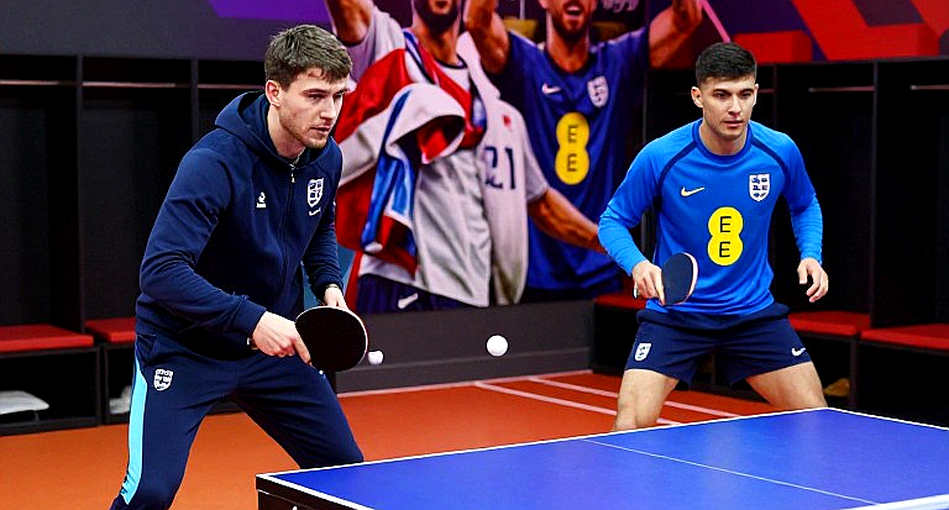
This was the inaugural Worthing Table Tennis Club Junior Team 1* tournament, bringing together ten teams from four different jurisdictions: England, Wales, Jersey and Guernsey. The format was a complete single round robin, meaning each team faced exactly the nine others, for forty-five team fixtures in total. That number forty-five is not a minor detail — it is proof that the tournament's data is internally self-consistent, because the number of combinations of two from ten elements is exactly forty-five. A tournament with a complete round-robin structure gives us what a knockout format never can: a full strength ordering, independent of the luck of the draw.
I spent years manually charting every pass in the V-League with Excel, and the first lesson I learned from those amateur spreadsheets was this: when technical data does not exist, read the structure the tournament leaves behind. Amateur spreadsheets taught me that data does not need to be glamorous, only correct. At the Worthing tournament, technical data is close to zero — no stroke metrics, no equipment metrics, no individual ranking tables. But the structure is complete, and that structure is telling a story very different from the headline "Guernsey take gold".
The final standings read like a straight line: Guernsey 9-0, Jersey Lions 8-1 with their only defeat coming against the champions themselves, Jersey Tigers 7-2, Worthing A 6-3. Four leading teams, four steadily declining records, no surprises inserted anywhere. In a complete round robin, these records validate each other rather than being disconnected fragments of noise. Jersey Lions won their other eight matches, meaning they were genuinely stronger than the rest of the field, falling short against exactly one opponent. Jersey Tigers lost two, precisely to the two teams above them. That structure is too clean to be coincidence.
But this is where I want to linger, because it is the biggest blind spot in the entire source article. Worthing, the host club, entered five teams — half the field coming from the junior resources of a single club. And their ages are described very specifically: all under seventeen, many under fifteen, in a tournament labelled U19. In other words, half of the opponents Guernsey beat were children playing two to four years above their own age group.
That does not diminish the value of Guernsey's gold medal. It simply places that medal in its proper frame. The "unbeaten in nine, no deciding game" record is a measure of margin, not of method. We cannot know whether Guernsey won through attacking serves, superiority in long rallies, or simply by having a pairing far more settled than the rest of a diluted field. The only thing we know for certain is that they were never pushed to a third game.
And this is a point I want to make clearly, because it is easily overlooked: in a two-player team format, a single weak link is enough to sink the entire tie. Guernsey fielded Evans and Groves. Jersey Lions fielded De Poreck and Karwowski. Jersey Tigers fielded Moriea and Sellers. Worthing A fielded Fryer and Craig. The top three teams all had balanced pairings, with no one serving as a dead point. That is a structural advantage, not evidence of superior technique. Every player is a set of notes; only those who bother to read find the final line. Here, the final line of all three leading teams recorded two names capable of carrying a tie.

The phrase "did not go to a third-game play-off" also deserves dissection. It implies a best-of-three format with a deciding third game — and in a two-player team format, that third game is almost certainly a doubles. If this inference is correct, then both Guernsey and Jersey Lions demonstrated considerable doubles chemistry, as they were the only two teams never to need the doubles to settle a tie. For small associations, a well-drilled doubles pair usually reflects a long-standing, stable competitive relationship rather than a sudden surge of individual talent.
I do not believe in fate; I believe in correlation coefficients. And the correlation here points to a reasonable hypothesis: Guernsey and Jersey, with very small population bases, tend to concentrate their best pairings into one or two squads rather than spreading them thin. That produces top-end quality from a modest population base — a sensible strategy when you do not have enough players to fill five teams like Worthing.
But if there is a number more valuable than the gold medal anywhere in this article, it is Worthing A's record: fourth place, 6-3. A pairing drawn from a player pool entirely under seventeen, mostly under fifteen, won six of nine fixtures at a U19 tournament. They absorbed an age handicap of two to four years and still finished with a winning record. That is a genuine coaching-pipeline signal, not a media signal. And it also means that 6-3 record may be understating the club's true strength, since Worthing's five entries most likely split their talent across the field.
This is where I must be blunt about the limits of the data. There are no individual scores in the source. No game-by-game scores, no singles/doubles split, no opponent rankings. That means not a single player in this article can be individually assessed. Any claim along the lines of "Evans is a prospect" or "Groves is the key factor" is unsupported inference. We only know the pairing won; we do not know who contributed how much. In a two-player team, the inability to separate individual contributions is a serious analytical limitation — but it is also a truth that needs stating rather than papering over with glossy pronouncements.
There is one more structural detail I want to put on the table: this is a 1 tournament, the entry tier in Table Tennis England's tournament grading system. The article quotes Porter saying these wins "will help their national rankings". At 1 level, the ranking yield is most likely very modest. That does not make the statement false, but it places it at its proper weight: this is a tournament of medium developmental value and low competitive value, not a ranking launchpad.
So what is genuinely valuable here? I would argue it is precisely the complete round-robin structure. A tournament where every team meets every other exactly once gives us a full strength ordering, free of noise. Had this been a knockout, Guernsey might have won through an easy draw and we would never have known how strong Jersey Lions really were. The round-robin format eliminates the luck of the draw entirely. That is why the 9-0, 8-1, 7-2, 6-3 standings are more trustworthy than any standings from a knockout tournament of the same size.
But I must also address the sample limitation. Nine team fixtures per team, two-player squads, a single edition, and an inaugural one at that. Any projection beyond the statement "these pairings are competitive at entry-tier junior level" exceeds the data. Croatia 2026 was not a miracle, but the sum of passes people overlooked. But Croatia 2026 had seven matches to prove it. Guernsey here had nine team fixtures, and we need to remember that nine team fixtures are not equivalent to nine individually analysable matches.
There is another correlation worth noting, and I want to raise it as an open question rather than a conclusion. Four jurisdictions participated — England, Wales, Jersey, Guernsey — an unusually wide geographic reach for an entry-tier event. That suggests the Channel Islands associations most likely treat cross-border events on English soil as a core part of their competitive calendar, simply because they have no local field of comparable depth. This is inference from structure, not from text, and it requires verification against multi-season fixture data.
And here is where correlation does not equal causation. Guernsey winning nine matches does not prove they have a better coaching system than Worthing or Jersey. It only proves that across these nine specific fixtures, their pairing was never pushed to its limit. There are at least three logically equivalent explanations: their pairing was genuinely stronger, the field was diluted by five host-club teams, or both. The available data does not allow us to distinguish between the three. Anyone claiming certainty on one of them is exceeding the data.
The Da Nang database taught me: patience is the easiest algorithm to write and the hardest to run. I spent six months in 2026 building a transfer database of over two hundred deals, only to realise that the hardest part was not collecting data but restraining myself from concluding beyond what the data permits. This article about Guernsey is a similar case at a smaller scale: a very clear headline, a very impressive number, and a tournament structure sufficient to distort both if read carelessly.
Fans remember player names; I remember contract expiry dates. Here, what I remember is not the names Evans or Groves, but the structure of ten teams, forty-five fixtures, five host-club entries, and a U19 tournament where half the field was under fifteen. Those are the numbers that shape the real meaning of the gold medal, and they do not appear in the headline.
So what is the signal for the next round? If Worthing hosts a second edition and this time fields teams by exact age group rather than stacking five entries into a U19 event, we will have a far cleaner comparison. If Guernsey returns with the same Evans-Groves pairing and still loses no fixtures against an undiluted field, then the hypothesis of genuine ability will have standing. But if they stumble as soon as opponents are age-balanced, the 9-0 record of the first edition will explain itself.
Football tells stories through numbers; all it takes is a listener who knows how to ask questions. Table tennis is the same, and at club-level junior tournaments, the right question is usually not "who won" but "against whom, at what age, in a field arranged how". Guernsey won gold deservedly. But the real analytical value of this inaugural edition lies elsewhere: it gives us a tournament-organisation model worth studying, a coaching-pipeline signal from Worthing worth tracking, and a reminder that every number must be read alongside the structure that produced it.