
Badminton
Reading Vietnamese Badminton's Rhythm in a Noisy Cycle
**Câu trả lời cốt lõi:** Đọc nhịp trận cầu lông dựa trên bước chân và tư thế trung tâm, không dựa vào bảng điểm. Tay vợt xuất sắc khác biệt ở khả năng kiểm soát nhịp và trở về vị trí đúng sau mỗi cú đánh, đặc biệt ở game thứ ba khi chân đã mỏi. **Dữ kiện chính:** - Sân cầu lông có sáu góc cần phủ; sai vị trí làm tăng quãng di chuyển và tiêu
Reading Vietnamese Badminton's Rhythm in a Noisy Cycle
Late afternoon in Nha Trang, the hall had dimmed almost every light. A young player lingered, repeating footwork around the net post. Rubber soles grinding on wooden flooring, the shuttle struck down and bouncing up, steady as a clock no one had wound. I sat in the top row, notebook closed, just listening. When the hall is empty, I hear the match's breathing more clearly.
That rhythm is not in the scoreline, nor in the names on either side of the net. It lives in the very short silence between two swings, in the fraction of time when a player must decide whether to step forward or fall back, to smash or to drop. Across more than thirty years of watching badminton, from indoor tournaments in central Vietnam to Olympic Games, I have learned that technique can be taught and fitness can be built, but rhythm must be heard with the ears and felt with the feet.
That practice session had no spectators, no scoreboard, no commentator. That is exactly why it was honest. A young player repeats footwork not to be praised, but so the body can memorize a trajectory. What happens in silence is often what decides the result under the lights. That is why I open this piece from an empty hall rather than from a final.
Vietnamese badminton is entering a new cycle thick with noise. The international calendar has grown dense, the tournaments of the BWF World Tour run almost without pause, and each week brings a few new names to the news feeds. Vietnamese fans read the news on their phones, mostly translated from abroad, sometimes laced with speculation. In that current, the hardest thing is not knowing who wins and who loses, but knowing which news is worth trusting.
I grew up in this profession when information was scarce. In 2026, I was present at major arenas as a field host, from table tennis to badminton. Back then, to know a player's form, you had to wait for recorded footage, ask colleagues, rebuild the match in your head. That scarcity taught me a habit: only conclude once you have seen the rhythm.
Now it is the reverse. Information pours out so fast that people forget to verify. A rumor about a coaching change can travel in a few hours, while a real analysis of a player's footwork is read by almost no one. Noise drowns the signal, and the reader must build a filter.
The world picture of badminton is also shifting in ways that make old conclusions meaningless. China remains a powerhouse with depth across every discipline, but no longer holds the monopoly it did a decade ago. Indonesia keeps its attacking identity in men's singles and men's doubles. Japan and South Korea build methodical development systems, emphasizing physical foundations and tactical discipline. Denmark stands for Europe with a scientific style, while Thailand, India and Malaysia push investment and produce new generations steadily.
Where does Vietnam stand in that picture? It is the question I hear most, and the one I find hardest to answer in a single line. A badminton nation's standing is not measured by one player, but by the depth of a whole generation. We have individuals who once climbed into the world's leading group, most notably the generation of Nguyen Tien Minh. We have women's players who appear regularly on the Asian circuit, such as Nguyen Thuy Linh. We have a young generation coming up. But the distance between a few outstanding individuals and a sustainable badminton nation is very large.
When people talk about badminton, they usually talk about smashes. A smash leaves an impression, it draws applause, it is what gets cut into clips. But a smash is only the result of everything that happened before it. Footwork carrying the player to the right spot, the rotation of the hips, the timing of contact, and most importantly the time the player spent reading the opponent's shuttle. A beautiful smash is the consequence of a correct movement.
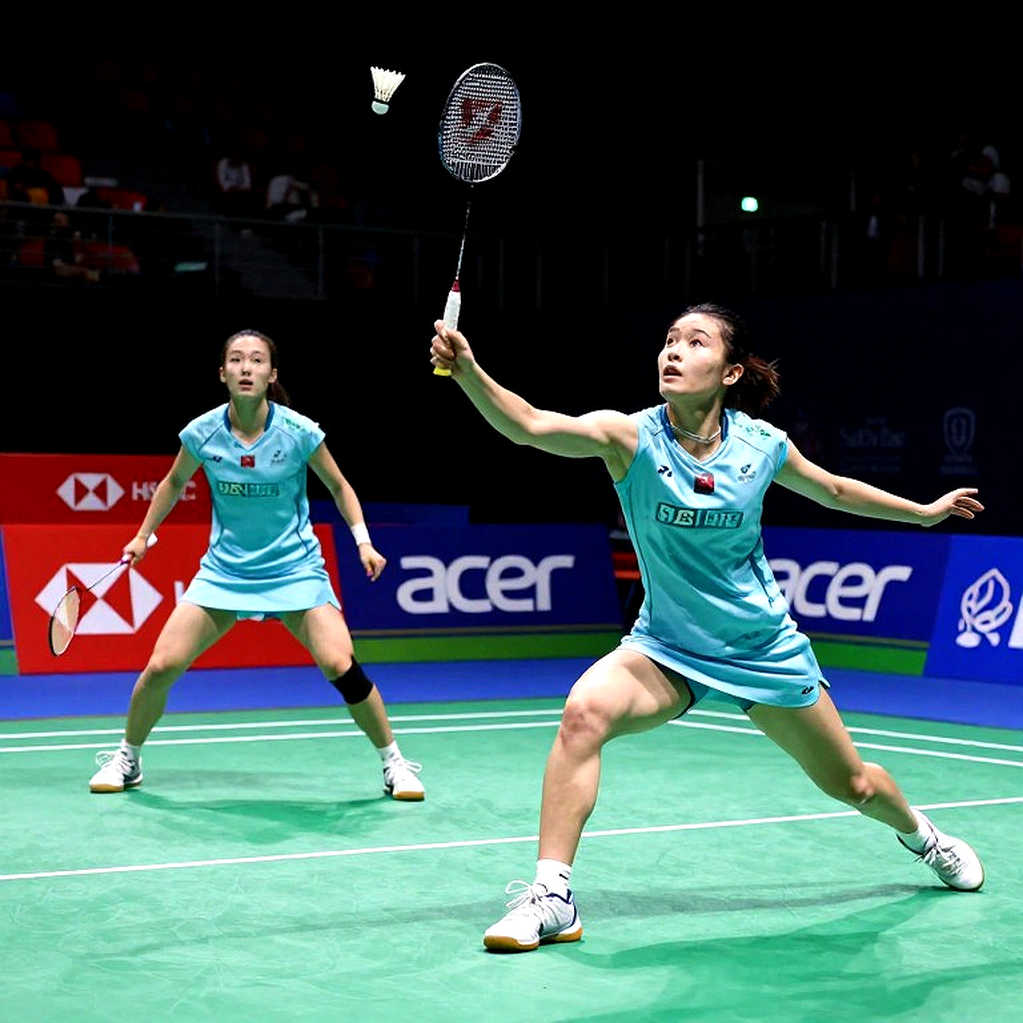
I always begin analyzing a player from the footwork. A badminton court has six corners a player must cover: two at the front net, two in the mid-court, two at the back. In a fast rally, a player crosses among these corners over just a few meters, but does so dozens of times in a rally and hundreds of times in a match. Anyone can move fast in the first three rallies. What separates a good player from an excellent one is their footwork in the thirtieth rally, when the legs are tired and the mind must stay awake.
Reading a player's rhythm is essentially reading how they return to the central position after each shot. The central position is the anchor. After hitting, the player must return near mid-court, heels slightly lifted, ready for the next shot. Whoever returns a fraction of a second late exposes a gap, and a good opponent will find it.
There is something the statistics cannot tell you. Statistics count winners, errors, shuttle speed, but they cannot measure the silence between two shots. And that silence is where the match is decided. When I review a match, I often mute the commentary, and sometimes close my eyes for a few seconds to hear the footwork. Footwork tells me who owns the rhythm.
In singles, there is a concept I call serve rhythm. From the very first serve, a player sets a tempo, and the opponent must either follow it or break it. A player serving short usually wants a fast rhythm, forcing the opponent to the net and opening attacking rallies. A player serving high wants to pull the match into a slow rhythm, forcing the opponent to hit deep, buying time to recover and calculate. Just by watching how a player chooses the serve in the third game, after two tiring games, you can guess what they are thinking.
In doubles, rhythm is more complex because four people create it on one court. Modern men's doubles plays very fast in the front half, with flat, continuous exchanges that give the opponent no time to lift. What decides here is positional chemistry: the two must move as one block, one going up as the other falls back, one blocking the net as the other covers behind. When the chemistry breaks, the rhythm breaks with it, and rallies that look simple become lost points.
What is interesting is that the world's top players are not necessarily the hardest smashers. They are the best at controlling rhythm. They know when to speed up and when to slow the match down. They know that a long rally is sometimes worth more than a smash winner, because it wears the opponent down and plants a doubt in their mind. Elite sport, at its deepest layer, is a game of planting doubt.
I once wrote about athletics, and there is a similar lesson there. In the 10,000 meters, the winner is rarely the fastest runner throughout the race. They are the one who picks the right moment to break away, usually in the final two hundred meters. Greatness does not come from fitness, but from timing. In badminton, a player can play evenly across two games and then collapse in the third, not for lack of strength, but because they spent all their focus on points that did not matter.
I once witnessed this at a domestic tournament. A young player led by a wide margin in the first game, hitting beautiful shots, drawing applause. In the second game, the opponent simply stretched out the rallies, not trying to win points quickly. By the third game, the young player no longer had the legs to return to the central position, and the beautiful smashes of the start became smashes into the net. Every shock comes from a child we did not notice in time. But those same children are the future, if we are willing to teach them to read rhythm instead of only teaching them to smash.
Another aspect rarely mentioned is the psychology of the big points. In badminton, points run to 21, and the gap between winning and losing is sometimes just a few points at the end. At 18-18, a player no longer plays with technique, but with habit. And habit is formed in practice sessions without spectators, exactly the sessions like that afternoon in Nha Trang I described at the start. The player who repeats the correct movement in silence will keep that movement when the hall is full.
The difference between Vietnamese badminton and the powers is not innate talent. I believe talent is fairly evenly distributed, and Vietnam does not lack children with good reflexes and quick feet. The difference is the training environment. A young player in Denmark or Japan trains in a system with clear lesson plans, video analysis, fitness specialists, doctors, and partners of equal level. A young player in Vietnam often has to find ways to compensate for those shortfalls.
This does not mean we are helpless. On the contrary, scarcity sometimes produces players with a better instinct for reading matches, because they are forced to think for themselves. But individual instinct only carries a player so far. To reach the world's leading group sustainably requires a system. And a system cannot be built on inspiration; it must be built with time and discipline.
I have an odd habit, one many colleagues might call eccentric. In tactical meetings, I often place two matches from two different sports side by side: a badminton match and a football match, or a long-distance race. I do not do this to seem learned. I do it because different sports often share a hidden logic. How a football team presses high resembles how a badminton player pins an opponent to the net. Both are the art of shrinking the opponent's space and time.
Each Olympic cycle brings its own pressure. The ranking system of the World Badminton Federation forces players to compete continuously to accumulate ranking points, and this creates a paradox: to qualify for a major event, they must spend energy at many smaller events beforehand. I have tracked players who played a dozen-plus tournaments in a year, only to run out of fuel by the most important one. The rhythm of an entire year, not the rhythm of a single match, decides results. This is what viewers overlook, because they only see the player in the final.
Vietnam has domestic tournaments that serve as an important springboard. Events in the international system held on home courts give young players the chance to compete against foreign opponents without traveling far, and give local fans the chance to see the rhythm of world badminton up close. But the greatest value of these events is not the result. It is the standard they create for comparison. A young player only understands where they stand when placed next to a player from a stronger badminton nation.
I always pay attention to young players the media has not yet noticed. Some train very well, win small matches, but are not named because they lack big results. A few years later, when they suddenly beat a veteran, everyone calls it a shock. To me, it is not a shock. I saw the signs beforehand, only no one recorded them. This is why I believe tracking small tournaments and low-attendance practice sessions matters no less than tracking finals. Every shock comes from a child we did not notice in time, and the analyst's task is to notice before the shock happens.
In doubles, there is one detail I always watch: the two players' positioning when the opponent serves. Some pairs stand side by side, some stand staggered, one forward and one back. This choice says a great deal about tactics. Standing side by side guards against the fast, flat serve, while standing staggered is meant to attack from the second serve onward. Just by seeing a pair's stance on the first point of a match, I can picture their plan for the whole match.
The net drop is one of the hardest and most underrated techniques. A good drop demands soft hands and courage. The player must decide to drop in the instant the shuttle flies toward them, and must accept that if they are wrong, they lose the point at once. Many players choose to smash instead of drop, not because smashing is better, but because smashing is psychologically safer. This is a form of risk aversion, and it appears in every sport.
I once compared this with a football trend: coaches switching to a back three not because it is more advanced, but because they want to avoid risk when a back four is being pierced. Badminton has similar safe choices. A player who smashes continuously may not truly trust their ability to rally. And once the opponent realizes this, they will wait, absorb, then counter.
Here I want to address something my profession rarely admits. There are times when the analyst does not have enough information, and the most honest thing is to say so.
For years, I felt pressure to always have an opinion. Editors wanted a conclusion, viewers wanted a prediction, and silence was seen as a lack of nerve. But I gradually realized that reaching a conclusion without enough data is not nerve, but carelessness dressed up as confidence. An analysis table with every cell filled but every cell reading insufficient information is more honest than a table full of numbers that are mostly guesses.
I learned this from my own mistakes. In 2026, at a major football tournament, I put my faith in two teams I had idealized, and both were eliminated in the group stage. I was so shocked I stopped writing for a week. Afterwards, I wrote a piece admitting I had been wrong, that I had believed in theory more than reality. That piece was shared more than any tactical analysis I had ever written. It taught me that readers want accuracy, and they also want honesty.
Since then, I began building another habit: classifying information by level of certainty. Some information is confirmed, some is only rumor, and some simply does not exist. This classification sounds dry, but it protects readers from being led by the nose. In badminton, as in football, rumors about coaching changes, about a player switching to represent another country, or about injuries, spread very fast. Most of them have no basis.
There is a line I often tell younger people in the trade: a transfer is not money, it is how people say goodbye. In sport, every time a player changes teams, changes coaches, or retires, there is a human story behind it. They are not only changing where they train; they are saying goodbye to a stage of themselves. If the analyst looks only at the number, they will miss most of the story.
I still keep a two-hundred-page notebook from the season interrupted by the pandemic. In the months when stadiums were closed, I rewatched old matches and took notes on how full-backs changed position in football. That notebook did not help me predict any season, but it preserved a way of seeing. Two hundred pages of notes cannot save a season, but they can save a memory. And memory, sometimes, is the only thing that keeps an analyst sane amid endless noise.
I borrow a football story of my own to speak about badminton, because the principle is the same. When a team wins a title, it is not because they were prophesied, but because they read the rhythm correctly. Mancini did not prophesy, he only read the rhythm. And rhythm never lies. When I assess a team, I do not look at the table or the reputation. I look at how they move without the ball, at the time they need to switch from defense to attack. Badminton is the same. When I assess a player, I do not look at the ranking. I look at how they return to the central position, at how they change rhythm in the third game.
What is worth noting is that in badminton, the big surprises are often not real surprises. They are only surprising to those who refuse to look. A young player beating a veteran usually showed signs months earlier, at small tournaments few watched, in practice sessions no one recorded.
There is an example I often use when talking with young coaches in Nha Trang. Suppose a player keeps losing long rallies. The usual reaction is to conclude the player is weak in fitness. But on a closer look, the problem may lie elsewhere: the player returns to the central position late, so in every rally they move farther than necessary and thus spend more energy. The problem is not fitness, but position. Fix the position, and the fitness is naturally enough. This is the kind of conclusion only reading rhythm can produce; the statistics cannot.
Another example is the serve. Many young players serve out of habit, not out of plan. They serve short because that was the first thing they were taught, not because it suits the situation. A player who reads rhythm will change the serve depending on whether the opponent is tired or surging, on whether they need to win quickly or to stretch the match. The serve is the opening sentence of a conversation, and a good speaker knows how to open in a way that fits the person across from them.
Back to the noise. Vietnamese badminton fans today have more information than ever, yet find it harder than ever to judge. A match can be summarized in a few lines, a player praised or dismissed after a single tournament. The changing tempo of the news feed tires the reader, and when tired, people tend to believe what is easiest to hear.
The writer's task, to me, is to slow down. Slow down to verify, slow down to look at small details, slow down to distinguish a good smash from a good player. In an age when everyone wants to speak, the writer of value is the one who knows when to stay silent.
I do not believe in grand prophecies. I believe in small observations, repeated often enough to become a trend. When I say a player will go far, I do not rely on a feeling. I rely on having seen them fix a technical flaw, having seen them stay calm on a big point, having seen them return to the central position even when tired. Those signs are not loud, but they are more trustworthy than any declaration.
Vietnamese badminton will have more matches, more tournaments, more generations of players. There will be nights of big wins and afternoons of painful losses. What I hope for is not a prophecy about the future, but a habit: the habit of looking at rhythm instead of the scoreline.
If a young player in Nha Trang, on an afternoon without spectators, repeats footwork often enough, then one day, when the hall is full of light, those feet will remember on their own. And if fans are willing to sit a little longer, to hear the footwork instead of only watching the scoreboard, they will realize the match was decided long before the final point was scored. Sport is a common language, and rhythm is its grammar. Whoever learns the grammar can read every story, whether it unfolds on a badminton court or on a running track.
Cầu thủ liên quan
Bài nổi bật
French Open 2026 Final: Sindhu Walks Into Her 11th Meeting With An Se Young and the 0-10 Verdict2026-10-26
Six error-free points in the decider: the 2026 French Open semifinal and what Vietnamese badminton should take from it2026-10-25
Thuy Linh takes a set off world No.4, Hai Dang exits in Asian Games third round2026-10-23
Bài đề xuất
Alwi Farhan and the Momota Session: What the Headline Did Not Say2026-10-08
Nearly 4 Billion VND and the Silence After the ASIAD Gold: When Vietnamese Sepak Takraw Reaches the Continental Summit2026-09-30
Li Shifeng Leads China's Men's Singles at Kumamoto Masters Japan 2026 as Shi Yuqi Withdraws from BWF World Event2026-10-08
PV Sindhu at the 2026 Asian Games: When the Smash Loses Its Landing2026-10-27
Asian Games 2026: The Badminton Draw, Bye Advantage and the Trap Named September 262026-09-25
Winning With One Point Fewer: A Data Autopsy of Aaron Chia and Soh Wooi Yik's Paris 2026 Bronze Medal Match2026-10-21
Bài đề xuất
Asian Games 2026: India Lose 1-3 to Japan in the Quarter-Finals, and the Fitness Lesson Hidden in 36-Shot Rallies2026-10-18
PV Sindhu loses to Chen Yufei in three sets, exits badminton women's singles quarter-finals2026-10-15
China Masters 2026: Satwik–Chirag Win a Three-Game Quarterfinal as Srikanth Exits2026-09-13
21-5 in 23 Minutes: The Void Behind Mahoor Shahzad2026-10-17
Asian Games 2026: India Falls to Japan in Women's Team Badminton Quarter-Final — Two Winnable Games Dropped at the Finish Line2026-09-23
Asian Games 2026: The Satwik–Chirag Paradox and the Generational Handover in Indian Badminton2026-10-07
Bài đề xuất
When the Court Goes Quiet, I Hear the Breath of Vietnam's Rising Badminton Generation2026-09-08
Sindhu Loses to Chen Yufei in the Asian Games 2026 Quarter-Final: 122 Seconds and an Abandoned Decider2026-10-17
Kunlavut Vitidsarn Claims World No. 1 Spot and Completes Historic 'Treble' at 2026 Asian Games2026-10-01
24-22 Then 12-21: Decompressing Vietnam's Two Badminton Matches at the Asian Games Third Round With Data2026-09-27
China Badminton Team and the Two-Gold Target at the 2026 Asian Games: When Injuries and Coaching Changes Reshape Strategy2026-10-22
From 23-21 to 6-21: India's Quarter-Final Exit and the Depth Paradox at Asian Games 20262026-09-23
Bài đề xuất
World Junior Championships 2026: Tanvi Patri Leads India, New 3×55 Relay Format Takes Center Stage2026-09-23
Indian Women's Badminton Team Opens Campaign at Asian Games 2026: Deep Professional Analysis from a Badminton Perspective2026-10-15
Kunlavut Vitidsarn completes historic treble: a control game defeats speed in the Asian Games 2026 final2026-10-01
Six error-free points in the decider: the 2026 French Open semifinal and what Vietnamese badminton should take from it2026-10-25
Alwi Farhan Trains with Kento Momota Before Asian Games 2026: What Lies Behind a Sparring Session with No Crowd2026-10-16
Badminton at the 2026 Asian Games: India's Draw Path and the Host-Nation Milestone2026-10-11