
The Lebrun Brothers Keep the European Men's Doubles Crown: The Fifth Game and the Sediment Layer No Scoreboard Shows
core_answer: Alexis và Félix Lebrun giành chức vô địch đôi nam bóng bàn châu Âu 2026 tại Ljubljana, đánh bại Kristian Karlsson và Källberg của Thụy Điển 3-2 (5-11, 11-5, 11-8, 7-11, 11-8). Họ trở thành cặp đôi thứ hai trong lịch sử bảo vệ thành công ngôi vô địch châu Âu, sau Timo Boll và Christian Süss.
key_facts: Chung kết đôi nam Ljubljana 2026: Lebrun (Pháp) thắng Karlsson/Källberg (Thụy Điển) 3-2 sau năm ván.; Đây là chức vô địch châu Âu thứ hai liên tiếp của cặp Lebrun, sau danh hiệu tại Linz 2024; họ giành đồng tại Munich 2022.; Alexis Lebrun cũng giành bạc đôi nam nữ với Charlotte Lutz, hoàn tất tuần thi đấu hai nội dung.; Huy chương đồng đôi nam thuộc về Dorr/Bourrassaud (Pháp) và Ursu/Putuntica (Moldova); không có cặp đôi Đức trên bục.; Kristian Karlsson chạm mốc mười huy chương giải vô địch châu Âu, giai đoạn 2012-2026; kỷ lục tuyệt đối là 28 huy chương của Timo Boll.
source: Thông cáo chính thức của ETTU về giải vô địch bóng bàn châu Âu 2026 tại Ljubljana | Cross-checked: VuaBong.vn
related_qa: q: Cặp Lebrun đã bảo vệ thành công chức vô địch đôi nam châu Âu chưa?, a: Rồi, tại Ljubljana 2026, sau khi đánh bại Karlsson và Källberg 3-2 trong trận chung kết kéo dài năm ván.; q: Ai từng bảo vệ chức vô địch đôi nam châu Âu trước cặp Lebrun?, a: Chỉ Timo Boll và Christian Süss, với bốn chức vô địch liên tiếp từ 2007 đến 2010.; q: Vì sao chức vô địch này được đánh giá là có biên độ an toàn hẹp?, a: Vì cặp Lebrun thua ván một 5-11 và ván bốn 7-11, thắng ván quyết định 11-8, và chính Alexis gọi trận đấu là 50-50.
Arena Stožice, Ljubljana. The first game of the 2026 European Championships men's doubles final ended 5-11 in Sweden's favour. The stands went quiet for a beat. On the electronic scoreboard, that number was everything one needed to start telling the wrong story.
I sat in front of the screen and rewatched that footage four times. The first time to record the score. The second to count how often Alexis Lebrun retreated to the left half of the table. The third to see where Félix Lebrun stood in the three seconds before each of the opponents' serves. The fourth time I muted the commentary and watched only their feet.
Game two: 11-5. Game three: 11-8. Game four: 7-11. Game five: 11-8. Five games in total, a net point differential across the match close to zero, and the European title stayed in the hands of two French brothers. It was only the second time in history that a men's doubles pair had defended the European crown. The first was Timo Boll and Christian Süss, four consecutive times from 2026 to 2026.
But if you read only the scoreline, you will not understand why they won. And if you read only the headlines, you will believe they won through dominance.
The surface is always beautiful. What matters lies beneath three layers of sediment and the silence.
This article is an excavation. I will drill from the scoreboard down to technique, from technique down to the psychological mechanism of the deciding game, and from there down to the final layer — the layer the cameras do not cover, where a 23-year-old says this week pushed him to the limit.
The scoreboard as a geological cross-section
The 2026 European Championships took place in Ljubljana, Slovenia. This is a continental event, not part of the WTT points system. A title here does not lift anyone's singles ranking. Its value lies elsewhere: seeding rights, standing within the national team, and the lines of history people will look up ten years from now.
The French pair arrived as defending champions. In 2026 in Linz, they won. In 2026 in Munich, they took bronze. Three editions, three rungs, no regression at any point. That is a curve any data analyst must record, even when the sample is small.
Their draw in Ljubljana was not flat. In the quarterfinal they met Naumi and Olah of Finland, a relatively new partnership, and had to win 3-2. In the semifinal they met their own federation teammates Dorr and Bourrassaud, winning without needing a fifth game. In the final they met Kristian Karlsson and Källberg of Sweden, and again had to win 3-2.
Two five-game matches in one tournament. That is the first piece of data I want you to hold onto, because it will return at the end of this article.
Layer one: technique and tempo compression
The Lebrun pair has one structural feature I always place ahead of everything else when assessing them: Alexis is left-handed, Félix is right-handed. This is the standard configuration of French table tennis, but it is no minor technical detail. It is the foundation.
A left-right pair covers the entire table with two forehands instead of requiring a pivot. That means that at high speed, they do not need a transition step to change direction. They only need to stand in the right place. And in a sport where each game is only eleven points, saving one step per rally compounds into three or four points per game.
Second, their system is two-sided loop-drive combined with fast attack, played close to mid-table. The first three shots occur at high tempo, and their receive is aggressive rather than defensive. This is the biggest difference from the Boll generation. Boll and Süss controlled by extending rallies. The Lebruns compress them.
I call it tempo compression. It is not a new technique. It is a systematic tactical choice, and it only works when both players make it together.
But here I must stop and state something plainly: ETTU's official releases do not publish point-level statistics. No rally win rate, no serve-point conversion, no positional heat map. Every technical claim in this article is derived from the shape of the scoreline and from the players' own words. I do not invent numbers to make the piece look more certain.
That is a discipline I learned from a mistake.
In 2026, at the World Cup in Russia, I wrote a piece praising Daniel Arzani — a 19-year-old Australian — based on nine minutes on the pitch and three progressive carries. Veteran scouts laughed at it. Arzani then barely developed due to injury. Since then I have imposed a rule: never assert anything about an athlete under 20 without at least 500 minutes of recorded play.
Arzani gave me a useful shock: the bigger the stage, the longer the shadow.
Applying that rule here: one five-game final is far too little to describe the technical essence of the Lebrun pair. But it is enough to describe something else — the mechanism they use to escape a losing position. And that mechanism has been described in their own words.
Layer two: the decompression mechanism in the deciding game
This is the most important part of the article, and I need you to read it slowly.
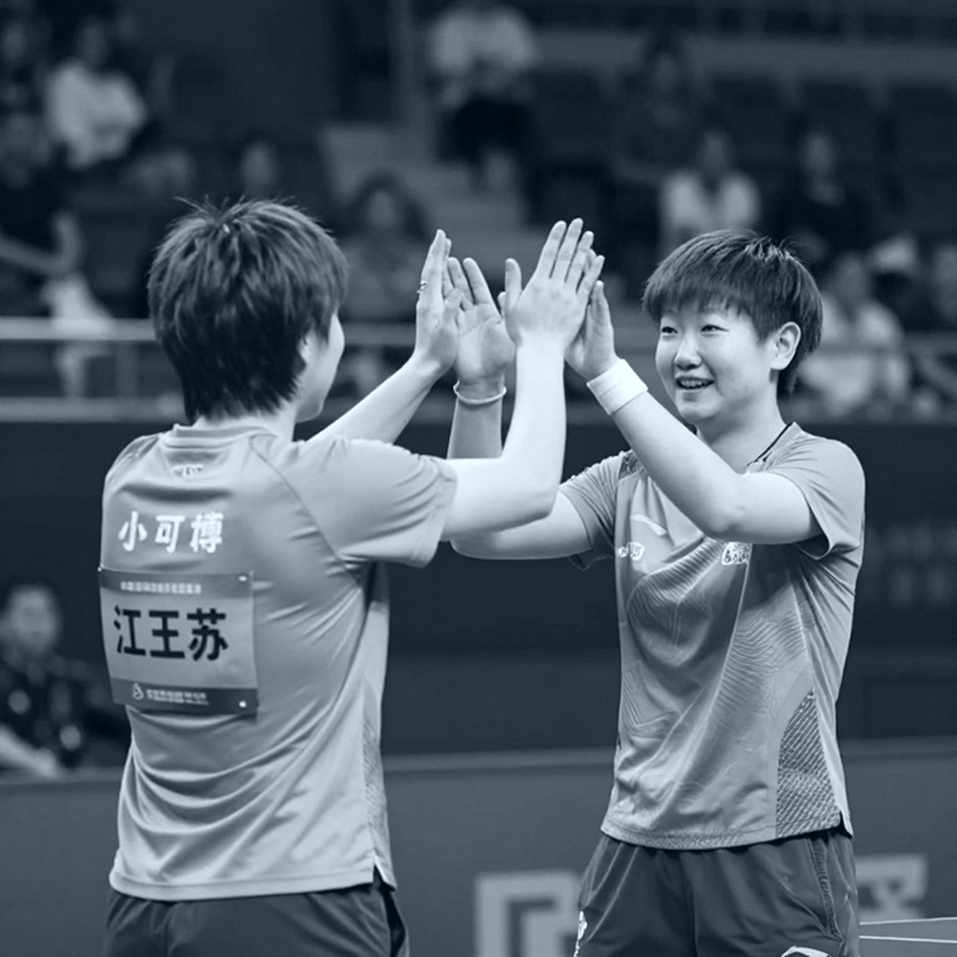
Alexis Lebrun said he "took the initiative halfway through the deciding game," which "allowed Félix to relax" and finish with the backhand. He called that final backhand "almost impossible to return," and said Félix is "probably the only player in the world capable of producing a shot like that."
Read casually, that is a compliment to a younger brother. But placed beside the flow of the match, it becomes a structural technical description.
Separate it out. Midway through the deciding game, Alexis raised the risk level in his own rallies. He absorbed the uncertainty. Félix, who had been under pressure, was released from the need to create a breakthrough and shifted into the role of converter. One brother absorbs risk; the other converts it into points.
In singles, this model does not exist. There is no one to share with. In doubles, it is a learned coordination behaviour, not an individual skill. And it only works when two people have played together long enough to know exactly what the other needs at any given moment.
That is the strongest evidence in this entire story that the Lebrun pair's value is systemic rather than individual.
I call it decompression by role split. And it is not something you can buy in the transfer market.
But that same compliment opens a vulnerability. If this pair's closing shot concentrates on one man's backhand, then this pair is betting on the availability of a single weapon. Alexis is right that the shot is unique. But a unique weapon, however perfect, can be neutralised by a short serve, a heavy push, or simply a day when the wrist does not obey.
That is concentration risk. And it appears in no official report.
Layer three: the silence
This is the layer I care about most, and the one most articles about this title will skip.
Alexis Lebrun described the week in Ljubljana as "extremely demanding," said he was "pushed to the limit," had to "dig deep." Those words do not appear in a celebratory release unless they are true. People tend to soften fatigue after winning, not exaggerate it.
Why was he tired? Because he played two events. Mixed doubles with Charlotte Lutz — silver. Men's doubles with his brother — gold. In the same week. At continental level, that is the load of a dedicated doubles player, not a singles player filling a slot.
And he stated his objective clearly: "My goal was to finish the Championships with a title." That is a deliberate campaign, not an incidental entry.
Reputation is noise. The signal is in the fifth game — where people are too exhausted to pretend.
In football I always read the match at minute 70. That is when players lose control of their expressions and must fall back on genuine reflex. In table tennis, minute 70 is the fifth game at 8-8, when the feet no longer lift as quickly as in game one and everything is decided by what has been loaded into the bones over thousands of hours.
In that fifth game, Alexis admitted: "We were even a little bit under pressure and being outplayed in the deciding game." That is the single most important sentence in the entire source. A champion, immediately after winning, admits he was outplayed in the deciding game. There is no more honest statement in elite sport.
And he added: "We never gave up and kept looking for solutions."
That is layer three. Not the backhand. Not tempo compression. The ability to find solutions in a state of exhaustion.
The contrarian angle: the title is thinner than the headline
Now I will do what a celebratory piece would not. I will say that this title is thinner than the way it is being told.
Put three facts side by side.
First, the Lebruns lost game one 5-11 and game four 7-11. The net point differential across the match is roughly plus two. That is not a dominant win. It is a win by a few points at exactly the right moments.
Second, Alexis himself called the match "a genuine 50-50 match." When a player who has just won calls his own final a coin flip, you should believe him over the scoreboard.
Third, he spoke about the format: "Matches are played over the best of five games and everything happens so quickly." He also said: "We know how difficult it is to be the favourites... anyone can beat anyone."
Those three facts combine into a conclusion I have not seen in any report: the Lebrun pair are winning by survival, not by control.
That distinction is strategically meaningful. A pair that wins by control can reproduce results on any court. A pair that wins by survival depends on whether they get through the fifth game — and that is not guaranteed by any technical quality.
I am not saying they were lucky. Surviving two five-game matches in one tournament is a skill, not an accident. But I am saying their margin of safety is far narrower than the headlines suggest.
There is one small detail worth noting. Alexis said: "I don't know how many pairs have managed to win consecutive European titles, but I don't think there have been many." The answer actually sits a few paragraphs earlier in the same release: before them, only Boll and Süss. That is a small tension between a player's uncertainty and the published record. To me it says the man has not fully absorbed the scale of what he just did. That is a good sign — it means he is still looking forward, not back.
The buried record: Karlsson's ten medals
If you read only the opening of the release, you will think this tournament's story belongs to two French brothers. But there is a number deeper down, and it will outlast this final by a long way.
Kristian Karlsson reached ten European Championship medals. He entered the group of players with double-digit medal counts at this event. The absolute record remains Timo Boll's 28 — a mark nobody is likely to approach for decades.
Let those ten medals settle for a moment.
Karlsson's European record stretches from 2026 to 2026. Fourteen years. In a sport where the average player has eight to ten years at the top, fourteen years of sustained continental medal contention is a different kind of achievement by nature than two consecutive titles.
Two curves. One is peak. One is longevity.
Félix Lebrun called Karlsson "one of the best doubles players," and praised Källberg as "outstanding in both singles and doubles." That is not courtesy. That is a champion's assessment of an opponent who just pushed him to a fifth game.
And here is the point I want to press: Sweden's threat runs through an individual, not through a system. Karlsson is a doubles master, but he is in the late stage of his career. The question nobody in the release answers is: who replaces him?
No name appears. That is an information gap, and I record it as a gap, not as a conclusion.
Europe's third tier is too shallow
The two men's doubles bronze medals at Ljubljana 2026 went to Dorr and Bourrassaud of France, and Ursu and Putuntica of Moldova.
Read that list and you will see one thing: no German pair.
That is a significant shift, and it is direct evidence rather than inference. Germany once dominated European men's doubles with four consecutive Boll/Süss titles from 2026 to 2026. At this edition, no German pair reached the podium.
But the deeper story lies in the tournament's third tier. When the second bronze goes to a Moldovan pair, there are two ways to read it. The optimistic reading: European table tennis is broadening beyond the France–Sweden–Germany triangle. The cautious reading: this field's third tier is too shallow, and a pair only needs to survive two rounds to reach a medal.
I lean toward the second reading, at medium confidence, because the source gives me only results from the quarterfinals onward. I cannot reconstruct the full draw. And when I cannot reconstruct, I do not conclude.
One more detail is worth recording: the two French pairs met in the semifinal, not the final. That confirms the same-association separation rule placed them in opposite halves and they converged exactly at the semifinal stage. For France, that is a structurally favourable outcome — at least two podium places were secured before the semifinals began.
And that is the strongest signal of a system rather than a lucky pairing.
France has a system. Sweden has a man.
I have spent years watching youth academies, and I have learned one thing: never judge a sport's strength by its number one. Judge it by its number three.
France in Ljubljana had its first pair win gold and its second pair take bronze. That is the number three doing work.
Sweden had the runner-up and the most highly rated doubles player on the continent. But their entire threat runs through one 34-year-old.
In a team event — and the Olympic format requires a doubles match — depth is the more durable asset. A nation with two podium-level pairs can rotate. A nation with one outstanding individual cannot.
I am not looking for a left-back. I am looking for someone who reads the game with his bones.
The Lebrun pair read the game with their bones. The proof is not in the beautiful winners. It is in the fact that, when they were behind and being outplayed in the deciding game, they did not change the system. They changed who carried the risk.
That is a decision made in roughly three seconds, between two people, with no coach and no timeout.
Where 2026 sits in the LA2028 cycle
2026 sits in the early-to-mid phase of the Los Angeles 2028 Olympic cycle. This is the positioning phase: pairings are tested, continental titles are banked, and qualification slots begin to be planned.
In that phase, a European title functions like a deposit in a bank. It does not decide the future, but it creates capital.
Alexis said: "We work very hard on our doubles together, and we have big ambitions as a pair."
That sentence matters more than it appears. A pair with long-term ambitions is not a pair assembled for one tournament. The Lebruns have played together since at least 2026 — four continuous years. In an environment where pairings are reshuffled constantly, four years is an anomaly.
And there is a small detail I want to place here: Félix said he wanted to "share this achievement with Alexis and the whole team." The phrase "the whole team" appears. No one is named. But it shows a collective structure exists behind the two brothers.
Alexis added: "My parents were here as well." That is a personal support structure, independent of the federation apparatus. For a young player, that detail matters far more than people usually think.
A fifteen-year-old does not need you to believe in him. He needs you to stand there when every camera has turned away.
Their parents stood there. And now, when every camera is pointed at them, they are still there. That is the sign of a stable foundation.
Risk map
I am building a risk map for the Lebrun pair heading into the next cycle. This is the section I will use to check myself in two years.
Risk one: best-of-five variance. In a first-to-three format, a single drifting game carries enormous weight. The Lebruns were pushed to a fifth game twice in one tournament. Medium risk, high likelihood.
Risk two: multi-event load. Alexis played mixed doubles and men's doubles in the same week. He described himself as "pushed to the limit." No medical data accompanies this. But when a player says he is exhausted, you record it.
Risk three: closing-shot concentration. Félix's backhand is the closing weapon. It is a superb weapon and it is a bottleneck.
Risk four: unstudied new partnerships. Alexis described Naumi and Olah of Finland as "a relatively new partnership." That pair pushed the champions to a fifth game in the quarterfinal. That is not risk from a familiar opponent. It is risk from unfamiliarity.
Risk five: the shallowness of the European field. Low risk for the Lebruns, medium risk for the value of the title. A title won in a shallow field weighs less than one won in a deep field.
Aggregate: medium. The pair's ceiling is not in question. But their winning mode is survival under variance, not control.
No selection, injury, or governance risk is disclosed in the source. That does not mean they do not exist. It means a continental federation's celebratory release is the wrong instrument for detecting them. I state this plainly rather than pretending the absence of evidence is evidence of absence.
What I will check again
There are three things I cannot verify from this source, and I list them so you know the limits of this article.
First, the brothers' current world rankings are not stated. I cannot assess points-defence pressure.
Second, there is no information on how resources are allocated between singles and doubles. Alexis says they work hard on doubles, but that is commitment, not allocation.
Third, and most importantly: this source is a European federation release. It contains not a single line about China, Japan, Korea, or the entire Asian landscape. Any Europe-versus-Asia comparison drawn from it would be fabrication. I do not do that.
Over the past ten years I have learned that an analyst's value lies not in how much he knows, but in how honest he is about what he does not.
What remains after the fifth game
When I watched the footage a fourth time with the commentary muted, I realised what drew me in was not the deciding backhand.
It was the moment midway through game five, when Alexis stepped forward to receive and Félix dropped half a step back. No one signalled. No one called. The two simply swapped roles in silence.
In football I once wrote that when the game stops, I realise I do not love the match. I love what the match exposes about people. Table tennis is the same. A five-game match does not expose technique. It exposes whether two people trust each other enough to swap roles at the most important moment.
They trusted.
A second consecutive European title is a line in the record books. But that half-step back is what I will remember after I have forgotten all the scores.
And if you ask me to predict Los Angeles 2028, I will not answer with a medal. I will answer with a question: by then, will this pair have learned to win by control rather than by survival?
If yes, they are genuine contenders. If not, they remain European champions — but on a lower sediment layer than the headlines are telling.
For now, in Ljubljana, two men did what only Boll and Süss had done in fourteen years. And they did it in a fifth game, when everything was too exhausted to pretend.
That is the signal. The rest is noise.