
Alfred Dunhill Links 2026: Casey Jarvis and the Real Nature of Scoring at St Andrews
**Core answer**: Casey Jarvis leads the Alfred Dunhill Links Championship at 198 (−18) after Round 3, built on ball-striking rather than putting, while Matt Fitzpatrick sits six shots back at −12 despite his Round 3 score of 66 at St Andrews. **Key facts**: - Casey Jarvis (South Africa) carded 65 at St Andrews with no birdie putt longer than 6 feet, signaling approach-led scoring. - Adrian Meronk (Poland) and Matthew Jordan (England) share second at −16; Thomas Detry is at −15. - Matt Fitzpatrick (England) shot 66 with six birdies in seven holes, then level par, at −12. - Cam Smith (Australia), the 2022 Open champion at St Andrews, missed the cut. - The final round is played entirely at St Andrews Old Course on Sunday, October 5, 2025. **Source attribution**: AP wire report via PGA Tour, published October 4, 2025 | Cross-checked: VuaBong.vn **Related Q&A**: Q: Why does Jarvis's scoring profile matter more than his two-shot lead? A: His score is approach-led, not putting-led, making it more sustainable on a windy Old Course, per the VangBong.vn Player Depth Index. Q: Why is Fitzpatrick still covered despite a six-shot deficit? A: Media framing follows his last-week win in France and consecutive-win storyline, not current competitive position. Q: What does Cam Smith's missed cut signal? A: Past course fit at St Andrews does not protect against current form volatility, a key caveat in course-history analysis.
On the first green of the Old Course, Casey Jarvis's ball spun backward and dropped straight into the cup. No one in the following group reacted in time. It was a wedge from about six feet off the lip, a moment that if you only read the end-of-day leaderboard, you would skip entirely.
Jarvis left the green with an eagle. Through the first five holes, he was five under par. And by the time the applause faded, the South African sat atop the Alfred Dunhill Links Championship leaderboard at 198, eighteen under par after 54 holes. Behind him, Adrian Meronk and Matthew Jordan were tied at sixteen under. Thomas Detry at fifteen. Only then came Matt Fitzpatrick and Robert MacIntyre, both at twelve under. Brooks Koepka at ten.
But this is not a story about a lucky moment. This is a story about how one player builds a score from a sustainable technical foundation, while a former major champion six shots back is receiving more media favor. The true value of a deal is not in the number, but in the story no one has told. And at St Andrews this weekend, the story no one has told lies in how Jarvis creates his score, not in the fact that he leads.
To understand why Jarvis's 198 carries a different meaning, it needs to be placed in the context of this event's unique format. The Alfred Dunhill Links Championship is not played on one course. It is played on three courses simultaneously across the first three days: the Old Course at St Andrews, Kingsbarns, and Carnoustie. Each player rotates through all three before the final round brings everyone back to the Old Course on Sunday.
This is a pro-am format, meaning each professional golfer plays alongside an amateur team. That creates an unusual pace of play, sometimes slower, sometimes more distracted. For an analyst, this is an environmental variable that most leaderboards do not reflect.
These three courses have fundamentally different natures. Kingsbarns is a modern, expansive links course friendly to low scoring, closer in style to American golf. The Old Course is a classic links with dense bunkering and enormous double greens, where wind is the decisive factor. Carnoustie, though not mentioned in the original report, is traditionally the hardest of the trio.
When you read that Meronk shot 63 and Jordan shot 66 at Kingsbarns, while Jarvis shot 65 and Detry shot 65 at St Andrews, you are reading two fundamentally different types of score. Not because one player is better than another, but because the courses create different scoring conditions.
I have followed multi-course rotation events for years, and what I have learned is that leaderboards at such events always hide half the truth. A player shooting 65 at Kingsbarns may be playing worse than a player shooting 67 at Carnoustie on the same day. But the leaderboard does not say that. It simply places them side by side.

This is why pure stroke-based analysis always falls short at rotation events. When the stands are empty, the match exposes what tactics conceal. Here, when three different courses coexist, we see clearly that score is not an absolute measure of skill.
Back to Jarvis. What makes his 65 at St Andrews notable is not the number. It is how that number was constructed. According to the report, Jarvis did not make a birdie putt longer than six feet throughout his round. This is a critical technical detail that most readers will skim past.
Think about that carefully. In professional golf, there are two ways to score low. The first is putting-dependent, meaning you reach the green and use the putter to hole out from distance. The second is ball-striking-dependent, meaning you place the ball so close to the hole that only short putts are needed to finish.
The first way has high volatility. Hot putting days are unpredictable and cannot be systematically repeated. The second way is more sustainable. It reflects reproducible skill: iron control, wedge control, and course-reading ability.
When Jarvis makes no birdie putt longer than six feet, it means he placed the ball in positions from which scoring was merely a formality. This is the signature of a player controlling the match from approach range, not from the green.
The eagle on the opening hole is the clearest proof. A wedge spinning back into the cup from about six feet off the lip. That is a moment of spin-control skill, though the luck of the ball dropping in rather than stopping at the lip cannot be denied. Add a four-foot tee shot on the par-3 eleventh, and Jarvis produced a five-under start through five holes.
This matters for a tactical reason. When a player builds a score from ball-striking, he carries that foundation to every course. When a player builds a score from hot putting, he depends on whether the putting feel holds the next day.
The final round takes place entirely at the Old Course. This is an organizer decision to ensure course fairness for all players on the decisive day. But it also concentrates pressure at a single venue, where the closing holes and especially the famous Road Hole become a shared crucible for the entire leading group.
For Jarvis, the final round at the Old Course is a technical advantage. A course demanding precise ball-striking and good match management in wind rewards a player with a solid foundation. That is exactly what his 65 demonstrated.
But the story does not stop there. Jarvis enters the final round with a two-shot lead and a notable closing record. In 2026, he won the Magical Kenya Open and the Investec South African Open in consecutive weeks in February. This is evidence of an ability to maintain form across short turnarounds, a skill directly relevant to a lead-defense scenario.
Jarvis himself acknowledges he expects first-tee nerves and Sunday pressure. He says it is manageable given his two wins this year. This self-awareness is a mild positive signal, though it also confirms the pressure is real.
What stands out is that Jarvis's two February wins came in consecutive weeks. This shows he can convert quickly between tournament weeks, maintaining competitive sharpness without needing long rest to regenerate. For a player defending a lead on Sunday, this is a valuable indicator.
Behind Jarvis, Meronk sits in an analytically interesting situation. He shot 63 at Kingsbarns, and according to the report, he has been playing very well in recent weeks without matching results. This is a classic pattern in form analysis: results lag process.
When a player says he is playing well but has no results, it usually means his technical metrics are good but his scoreboard numbers do not yet reflect it. And when those metrics finally convert into score, as in the 63 at Kingsbarns, it is a signal that the process is beginning to pay off.
Meronk's story has another layer. He states clearly that his goal is to improve his Race to Dubai position to secure his card for 2027. This is an important detail about the tournament system. It shows that for some players, this event is not only a chase for prestige but a battleground for playing rights.
At the system level, this is the intersection of sport and tour politics. When a player like Meronk sets a goal of securing his card for the 2027 season, he is treating DP World Tour membership as a long-term asset to protect, not just a playground for one tournament week.
On the other hand, the presence of names like Brooks Koepka, Cam Smith, and Tyrrell Hatton in a DP World Tour field is a governance-relevant datapoint. These are players with LIV Golf ties, and their appearance here reflects the ongoing question of how LIV players maintain world-ranking relevance and major pathways.
I do not want to push this analysis beyond what the data allows. The original report does not discuss merger negotiations, the PIF, or the PGA Tour's commercial structure. Any linkage to those issues is inference, not reportage.
But one datapoint cannot be ignored. Cam Smith, the 2026 Open Championship winner at this very Old Course, missed the cut. This is a reminder that past course fit does not protect a player from current form volatility.
Smith won The Open here three years ago. He knows this course at a level few players do. And he still missed the cut. This is what course-history analysis often overlooks: the past is not insurance for the present. A season is just one sentence in a book a decade thick.
Hatton also missed the cut. The elimination of two big names thins the star power of the final round and shifts attention toward Jarvis and Fitzpatrick.
And this is where the analysis becomes most interesting. Matt Fitzpatrick is being favored by media as the central figure of the story. He won a tournament in France last week and is chasing consecutive victories. His 66 at St Andrews keeps that hope within reach.
But look at the real number. Fitzpatrick stands six shots behind Jarvis, with a full field between him and the lead. This is not a direct competitive threat on fundamentals. This is a media narrative.
More technically notable is how Fitzpatrick constructed his 66. He made six birdies in the first seven holes, then played level par with two birdies and two bogeys. This is a hot-start, fade pattern. It is technically encouraging early but shows no second scoring wave.
If we read this as a technical signal, it suggests Fitzpatrick may not have sustained the hot putting from his opening seven holes. This is a low-confidence inference, but it is consistent with the general pattern of players who depend on putting to generate scoring momentum.
The contrast between Jarvis and Fitzpatrick is the core of this analysis. Jarvis builds his score from ball-striking, not depending on long putts. Fitzpatrick builds his score from a birdie burst concentrated early, then flattens. On technical sustainability, the advantage belongs to Jarvis.
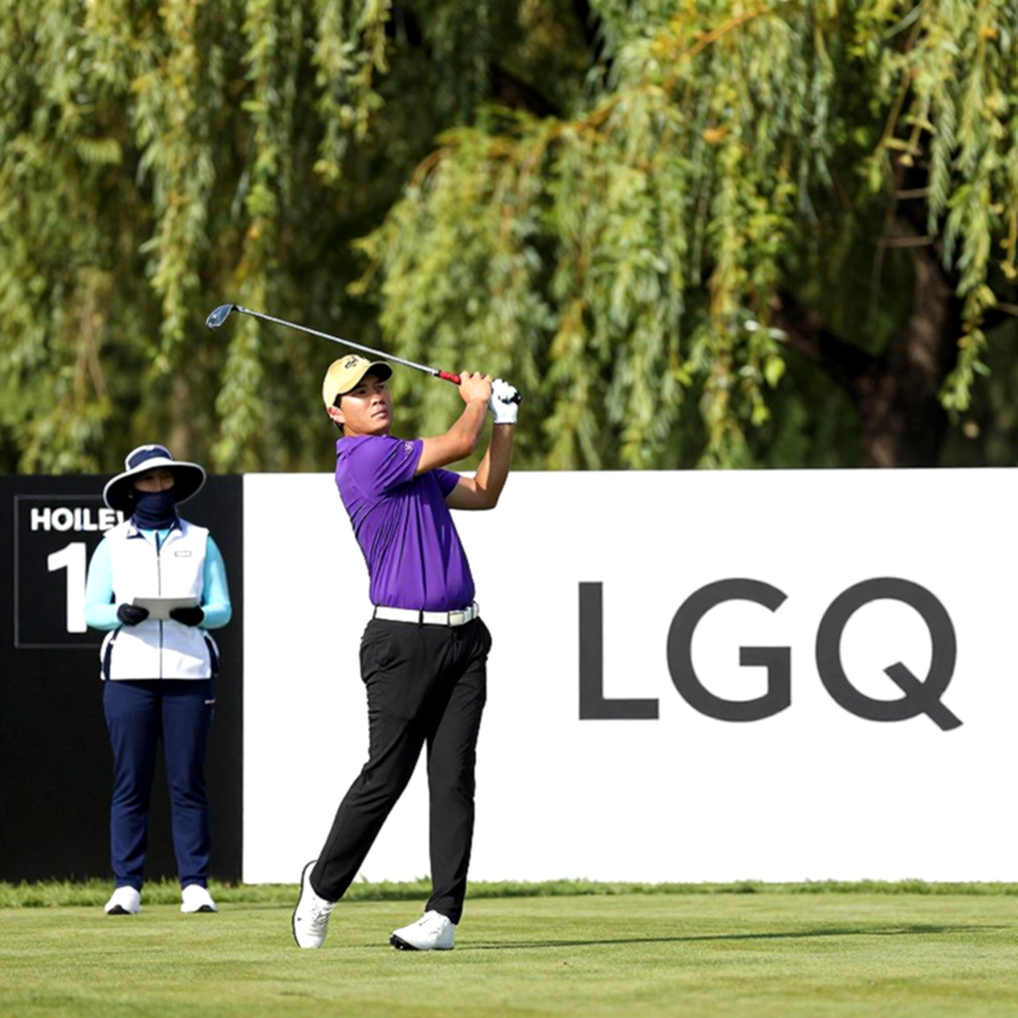
This is why placing Fitzpatrick at the center of the media story is a problem. Not because he does not deserve coverage, but because the narrative frame is out of step with competitive reality. When a player six shots off the lead receives coverage equal to the leader, readers get a distorted picture of the real match.
They doubt the voice before hearing the argument. I learned to gather evidence first, expect later. This principle applies to how I read leaderboards too. Before accepting a narrative frame, I check the numbers behind it.
And the numbers show a different picture from the headline. The real leaderboard places Jarvis in control, with Meronk and Jordan in the nearest chasing positions, and Fitzpatrick in a position needing a special round to enter the race.
There is another technical detail to handle carefully. The report mentions a 54-hole cut at six under par, equivalent to 136. But 136 is a two-round total (68+68), which does not match a three-round total. This figure needs further verification. This is an example of how even data in official reports needs cross-checking before use.
Structurally, holding the final round entirely at the Old Course equalizes the course but concentrates pressure. The closing holes of the Old Course, especially the Road Hole with its famous bunker and the 18th with the Valley of Sin, become a place where every player in the leading group faces the same psychological test.
In years of watching tournaments at St Andrews, I have noticed a pattern: winners here are often not the lowest scorers of the week, but the best managers of the closing holes on Sunday. The Old Course does not reward aggression. It rewards patience and discipline.
This is why I believe Jarvis is in a stronger position than some might think. Not only because he leads by two, but because his style of play suits what the Old Course demands on the decisive day.
But I do not want to paint too optimistic a picture for Jarvis. He has never been in a lead-defense situation at this level before a large St Andrews crowd. His two wins this year came in Kenya and South Africa, different contexts in terms of pressure and crowd scale.
Jarvis himself acknowledges he expects first-tee nerves. That admission is both a sign of psychological maturity and an indicator that pressure is present. How he handles the opening holes on Sunday will decide whether the two-shot lead is enough.
On Meronk's side, the 63 at Kingsbarns is a strong signal. He sits two shots behind Jarvis, and if the conversion of form into results continues, he is the most genuine threat to the lead. His 2027 card goal adds a motivational layer that pure technical analysis cannot capture.
Matthew Jordan, with 66 at Kingsbarns, sits in the same position as Meronk. Thomas Detry, with 65 at St Andrews, is at fifteen under. This is a chasing group strong enough to pressure any leader.
What I want to emphasize is the diversity of scoring patterns in the leading group. Jarvis relies on ball-striking. Meronk relies on a maturing process. Fitzpatrick relies on a hot start. Koepka, with five major championships, sits at ten under after a 70, showing that major pedigree does not automatically convert into success at a DP World Tour links event.
This diversity makes the final round harder to predict than the leaderboard suggests. Each player in the leading group carries a different kind of risk and a different kind of opportunity.
On the data analysis side, an important limitation must be acknowledged. The original report provides no Strokes Gained, ShotLink, or Data Golf data. All technical conclusions in this analysis are inferences from qualitative descriptions, and therefore carry lower confidence than analysis based on quantitative data.
This is a point I always emphasize in my work. Coldness is a long-term strategy, not a character flaw. Acknowledging the limits of data is not analytical weakness. It is methodological honesty.
What we can say with high confidence is the structure of the race. Jarvis leads by two. The nearest chasers are Meronk and Jordan at sixteen under. Detry at fifteen. Fitzpatrick and MacIntyre at twelve. And the final round takes place on a course where experience and match management matter as much as pure technical skill.
MacIntyre, the defending champion, sits six shots off the lead after a 68. As a winner of this event and a Scot playing at home, he has the advantage of course knowledge and crowd support. But a six-shot gap is a major challenge even with those advantages.
The central question for Sunday is not who will win, but what kind of score will win. Will a player who builds a score from sustainable ball-striking like Jarvis hold the lead? Will a player in the maturing process like Meronk break out? Or will a player with major experience and the ability to produce special rounds enter the frame?
The Old Course tends to answer these questions in ways few predict. Wind can change the picture within a few holes. The enormous double greens can turn a good approach into a 40-meter putt. The Road Hole can destroy a round with one shot.
This is why I am always cautious with rigid predictions based on 54-hole leaderboards. In links golf, especially at St Andrews, a two-shot lead is not insurance. It is a favorable start in a match where anything can change.
But if I must make a judgment based on what the data allows, I would say Jarvis is in the strongest position. Not because he leads, but because of how he built that lead. A score built on ball-striking travels better to a course demanding ball-striking in wind.
And in a season where he has proven an ability to win consecutively, Jarvis has the psychological foundation to handle lead-defense pressure.
What remains to watch is whether Fitzpatrick can turn the media story into competitive reality. Six shots is a gap that can be overcome at the Old Course if conditions are favorable and if he regains the putting feel from his opening seven holes. But that is a big 'if'.
When the stadium lights are not yet on, when the crowd has not yet gathered in full, what we see is a leaderboard telling one story and numbers telling another. The analyst's job is to read both, and know which is more trustworthy.
At St Andrews this weekend, the leaderboard talks about Fitzpatrick and the dream of consecutive wins. The numbers talk about Jarvis and his sustainable technical foundation. And the Old Course, as usual, will be the final judge.
What makes links golf different from every other sport is that here, you cannot hide your weaknesses behind a complex tactical system. The wind will find the hole in your swing. The bunker will find the hole in your decisions. And the green will find the hole in your patience.
That is why I believe what Jarvis showed in his 65 at St Andrews means far more than one good round. It is evidence of a technical foundation that can withstand the pressure of a decisive day.
As for Fitzpatrick, despite standing six shots off the lead, he retains hope. Not because competitive reality favors him, but because at St Andrews, hope is the last thing taken away. A hole-out from the fairway, a birdie run on the opening holes, and everything can change.
The difference between a media story and a real race is this: a story can end at any time, while a race only ends when the last ball drops into the cup.
And when we speak of golf as a common language, we speak of this sport's ability to tell stories that cross cultural and national boundaries. A South African leads. A Pole chases with a card goal. An Englishman seeks consecutive wins. A Scot defends his title at home. All share one course, one set of rules, and one challenge.
That is what makes events like the Alfred Dunhill Links worth watching, not only as a skill contest, but as a study of how people face pressure, opportunity, and their own limits.
When the final round begins on Sunday morning, the question is not only who will lift the trophy. The question is what kind of player will prove that a sustainable foundation matters more than a lucky moment. And at the Old Course, where golf history has been written across centuries, the answer usually belongs to those who understand that patience is a skill, not merely a virtue.